
Fukupochi
image

Is Consumption Tax Due on International Money Transfers? Case Studies and How to File Tax Return

2026-03-10  |  Fukupochi (Formerly Curfex Japan)

Do you need to support the living expenses of your child who is studying in the U.S.?

Do you live in South Korea and have plans to receive remittances from a friend in Japan?

If you live abroad or have family or friends living abroad, the money transfer should be processed through an international money transfer service.

In recent years, international money transfers have become more popular and accessible not only through banks but also through online services. Although this has made the procedure easier, many people may not yet be accustomed to the system, such as the various fees incurred due to currency differences and how the transferring amount changes depending on rate fluctuation.

One of the common questions that often arises is whether "taxes" are applied to international money transfers.

Without a proper understanding of the taxation of international money transfers, you may find yourself in violation of your tax obligations without even knowing it. Those who currently use or plan to use international money transfer services are well advised to check whether consumption tax and other taxes will be imposed on international money transfers.

In this article, we will discuss in detail whether taxes are imposed on international money transfers, which cases are subject, and how to report them.

Are International Money Transfers Subject to Consumption Tax?

First, let’s review whether international money transfers are subject to consumption tax.

Consumption tax is imposed when money is spent. So, in the case of international money transfers, it should be viewed as a tax that is imposed on the sender, not the recipient. As it turns out, no consumption tax is imposed on international money transfers.

The Consumption Tax Law in Japan stipulates tax exemptions, of one of which indicates that the consumption tax on fees incurred with international money transfers are tax exempt.

​​Consumption tax is imposed on monetary transactions in Japan. Many people mistakenly believe that international money transfers from Japan to foreign countries are subject to consumption tax since they are performed in Japan. However, these fees are exempt from taxation as they are defined as non-taxable.

When sending money overseas, various fees are imposed, such as transfer fees, exchange fees, and intermediary bank fees. As a result, in many cases you will end up needing more funds than initially expected.

But as far as consumption taxes are concerned, there is no need to worry about having to pay an additional amount for the fees incurred.

Types of Taxes Imposed on International Money Transfers

So, is there absolutely no need to worry about taxes at all when it comes to international money transfer transactions? The answer is no– there are taxes other than consumption taxes that are relevant to international money transfers.

The taxes listed below are those that may incur upon receiving international money transfers. Be sure to check them carefully in advance.
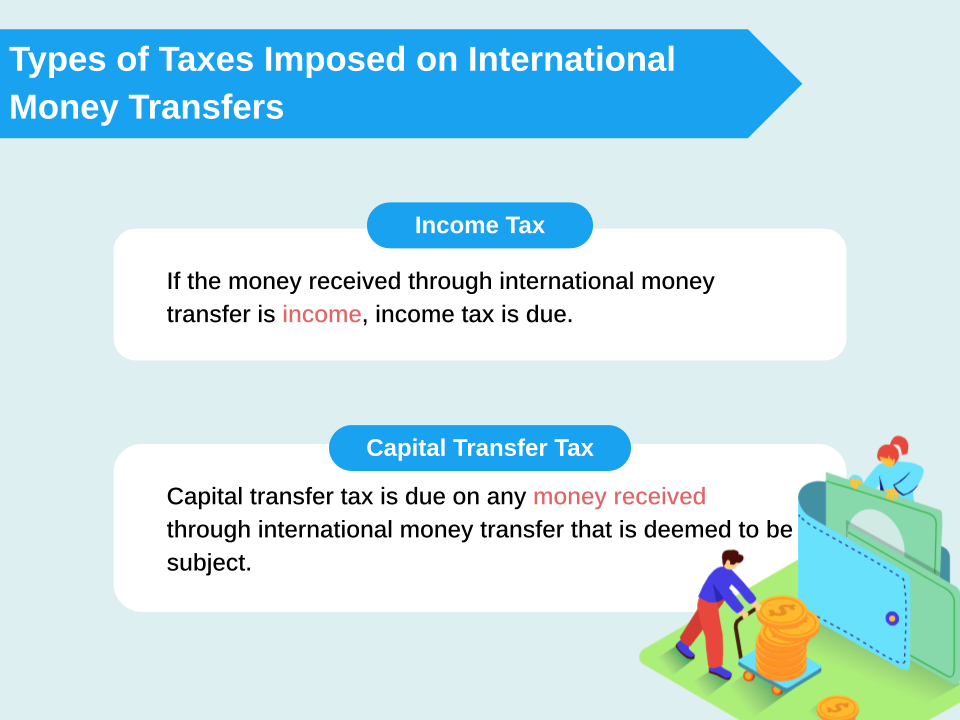
Taxes on International Money Transfers: Income Tax

First, we will look at income tax.

If the money received through international money transfer is income, income tax is due.

Income tax applies to money received as wages or earned through one's own business or other activities. Therefore, income tax is also imposed when you receive profits from overseas business development, and income from real estate held abroad is also subject to tax.

Some people think that income tax is levied only on work or business in conducted Japan, but be sure to remember that income generated overseas is also subject to taxation.

Taxes on International Money Transfers: Capital Transfer Tax

Another type of tax that may be relevant to international money transfers is the capital transfer tax.

Capital transfer tax is due on any money received through international money transfer that is deemed to be subject.

If the sender and recipient both have an address in Japan, the transfer is most likely be deemed subject to taxation. On the other hand, if one of the addresses is outside Japan, the criteria will be a little more complex.

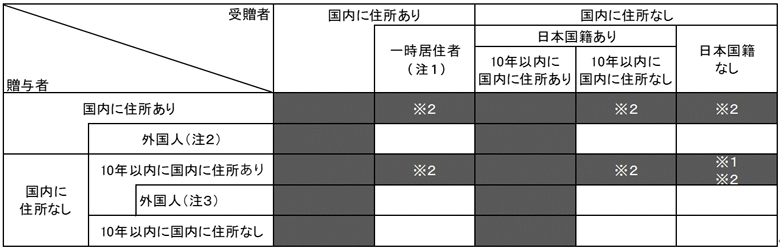
The detailed conditions under which an international money transfer is subject to capital transfer tax are as follows:

Case 1: The sender is a Japanese national, and their address is in Japan

A capital transfer tax is incurred regardless of the recipient’s address.

Case 2: The sender is a non-Japanese national, and their address is in Japan

A capital transfer tax is incurred if the recipient is a Japanese national whose address is in Japan or who had a Japanese address within the past 10 years.

Case 3: The sender is a Japanese national and their address is outside Japan, but they have had a Japanese address within the past 10 years

A capital transfer tax is incurred regardless of the recipient’s address.

Case 4: The sender is a non-Japanese national whose address is outside of Japan

A capital transfer tax is incurred if the recipient is a Japanese national whose address is in Japan or who had a Japanese address within the past 10 years.

Case 5: The sender’s address is in Japan, and they haven’t had address in Japan within the past 10 years

A capital transfer tax is incurred if the recipient is a Japanese national whose address is in Japan or has had address in Japan within the past 10 years.

Reference: IRS

https://www.nta.go.jp/taxes/shiraberu/taxanswer/zoyo/4432.htm

Simply put, a capital transfer tax is incurred in the cases where the sender or recipient has an address in Japan either in the past within 10 years or present.

If you would like to see further details, you can check from the IRS website.

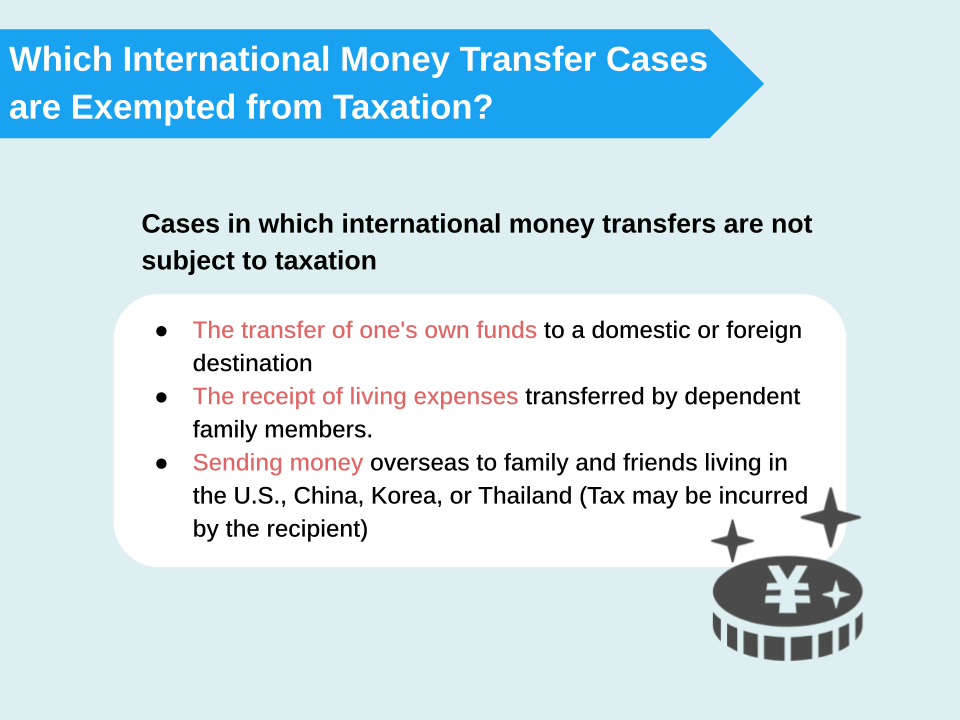
Which International Money Transfer Cases are Exempted from Taxation?

We have looked at the types of tax and cases subject to them. But there are also cases in which international money transfers are not subject to taxation.

In this section, we will provide some examples of cases in which taxation is exempted.
Transfer of Funds in Possession

The first case is the transfer of one's own funds to a domestic or foreign destination.

If you study or travel abroad for work, it is quite common to open a new account in the destination country in addition to your domestic one.

No capital transfer or income tax is imposed on the transfer of your own fund from your overseas account to your Japanese account, as it is merely considered a transfer.

If you’re worried about having to pay taxes every time you transfer your own money, there is no need for that!

Receiving Living Expenses

Likewise, no tax will be incurred for the receipt of living expenses transferred by dependent family members.

Money transfers to dependant family members are deemed as remittances of necessary living expenses for education or childcare. If you send money to your family members for studying abroad or overseas business trips, it is subject to tax exempt. In this case, the taxpayer is required to submit Documents Concerning Relatives and Documents Concerning Remittances to the withholding agent at the time of filing the tax return.

However, you should also be aware and careful that it may not be recognizes as living expenses if the money sent is used for other purposes.

Please note that this tax exempt only applies to dependent family members. Money transfers to friends who lived with you or to to family members who are not your dependents will not be eligible.

Taxes Incurred with Money Transfers to the U.S.

Now, let’s take a look at the types of taxes incurred when transferring money to family and friends, using the U.S. as an example destination.

When transferring money to the U.S., there is no consumption tax on the remittance fee, so there is no tax incurred on the sender's end.

On the other hand, the following taxes may be imposed on the recipient:

  • Capital transfer tax
  • Income tax

If the remittance is from a dependent family member and is for living expenses, it is exempt from taxation; otherwise, a capital transfer tax is due. In addition, income tax is due on money received from a company or from one's own business.

Be sure to check the classification of the fund to be sent first, and then check for any taxes that may be incurred.

Taxes Incurred with Money Transfers to China, Korea, and Thailand

Next, we will look at money transfers to Asian countries such as China, Korea, and Thailand.

There is no consumption tax is imposed on the remittance fee in this case, so again, there is no tax incurred on the sender's end.

However, the recipient may be subject to the following taxes:

  • Capital transfer tax
  • Income tax

As with remittances to the U.S., these remittances are also exempt from tax when sent by dependent family members as living expenses, but capital transfer tax is due on other remittances.

Even if it is not treated as a capital transfer tax, it may still be considered income tax if the money is income from a company or earnings from one's own business.

Please check in advance which classification the money you send applies to, so that you know whether or not it is subject to taxes.

How to Report Taxes Incurred on International Money Transfers

So, how should you report the taxes incurred on international money transfers? In this section, we will go over the steps and conditions of filing tax on international money transfers.
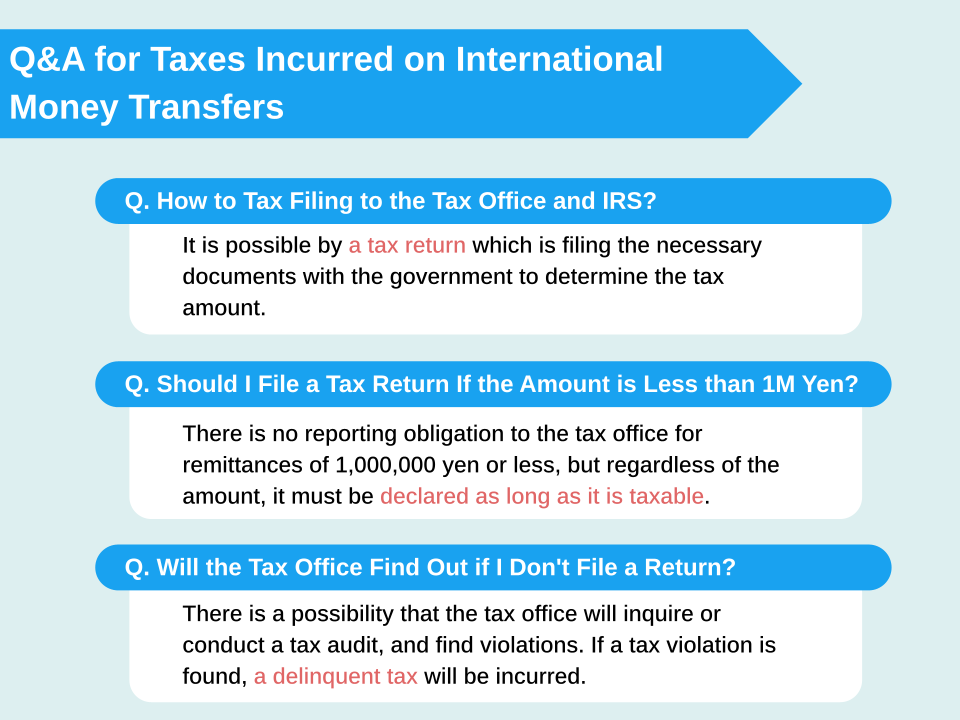
Tax Filing to the Tax Office and IRS

Income tax and capital transfer tax incurred through international money transfers are subject to the annual tax return.

A tax return is a procedure whereby income from January 1 to December 31 is reported to the government between February 16 and March 15 of the following year to determine the amount of taxes due.

It may seem difficult for those who have never done it before, but online tax filing has recently become available, saving the hassle of having to submit a number of documents to the tax office.

You can file your tax return using one of the following methods:

  • Bringing the declaration documents to the tax office and completing the procedures
  • Sending the prepared documents to the tax office by mail
  • Completing the procedure online using e-tax

Please be sure to complete the procedure by the deadline using a method of your choice.

Should I File a Tax Return If the Amount is Less than 1M Yen?

If the amount received by remittance exceeds 1,000,000 yen, the financial institution is required to report this to the tax office. In other words, there is no reporting obligation to the tax office for remittances of 1,000,000 yen or less.

Many of you may be wondering, “does that mean I don’t have to file a tax return if the remittance amount is smaller than 1,000,000 yen?” The answer is; regardless of the amount, it must be declared as long as it is taxable.

Financial institutions are not obliged to report remittances over 1,000,000 yen, but that does not necessarily mean they don’t report them.

Regardless of whether you are obliged to report or not, the tax office may check whether you have declared your tax by remittance, so be sure to complete the procedure.

Will the Tax Office Find Out if I Don't File a Return?

If a taxpayer fails to file a tax return, there is a possibility that the tax office will inquire or conduct a tax audit as a check against income tax and capital transfer tax due to remittances, and find violations.

If the tax office finds a failure of tax payment, a delinquent tax will be added to the amount of taxes that should have been paid. Thi is like a penalty, so the more delinquent you are, the higher the percentage amount will be added to your tax bill.

You may feel lucky that you didn’t have to pay tax, but you will end up having to pay an extra amount as a result.

Is There a Refund for Taxes on International Money Transfers?

Income taxes incurred on money received through international money transfers are eligible for the foreign tax credit.

This is a refund for income earned in a foreign country for which both Japanese and foreign taxes have been paid, resulting in double tax payments.

To take advantage of the foreign tax credit, proof of payment of taxes incurred abroad is required when preparing tax return documentation. By submitting documents that confirm how much you have paid overseas for taxes when filing your tax return, you can receive a refund for double tax payments.

Tax returns tend to give the impression that you have to pay a lot, but if you file it correctly, you will be eligible for a refund for the amount you have lost. Make sure you complete the procedure as instructed by the relevant authorities.

Why Fukupochi is the Best Choice for International Money transfers
In this article, we have looked at the types of tax incurred with international money transfers.

When sending money overseas, it is essential that both the sender and recipient have good knowledge of taxes as they go through the procedure. Make sure to obtain accurate information, otherwise, you can be evading taxes without even knowing it.

Although it is mandatory to provide correct information when filing a tax return, many people may find it difficult to prove the record of all transactions, especially those who transfer money on a frequent basis.

Fukupochi (formerly Curfex Japan) is an international money transfer service that offers the issuance of a certificate of remittance.

Having a certificate with the correct record of the remittance allows for more accurate filing to the relevant authorities, thereby preventing problems related to taxes.

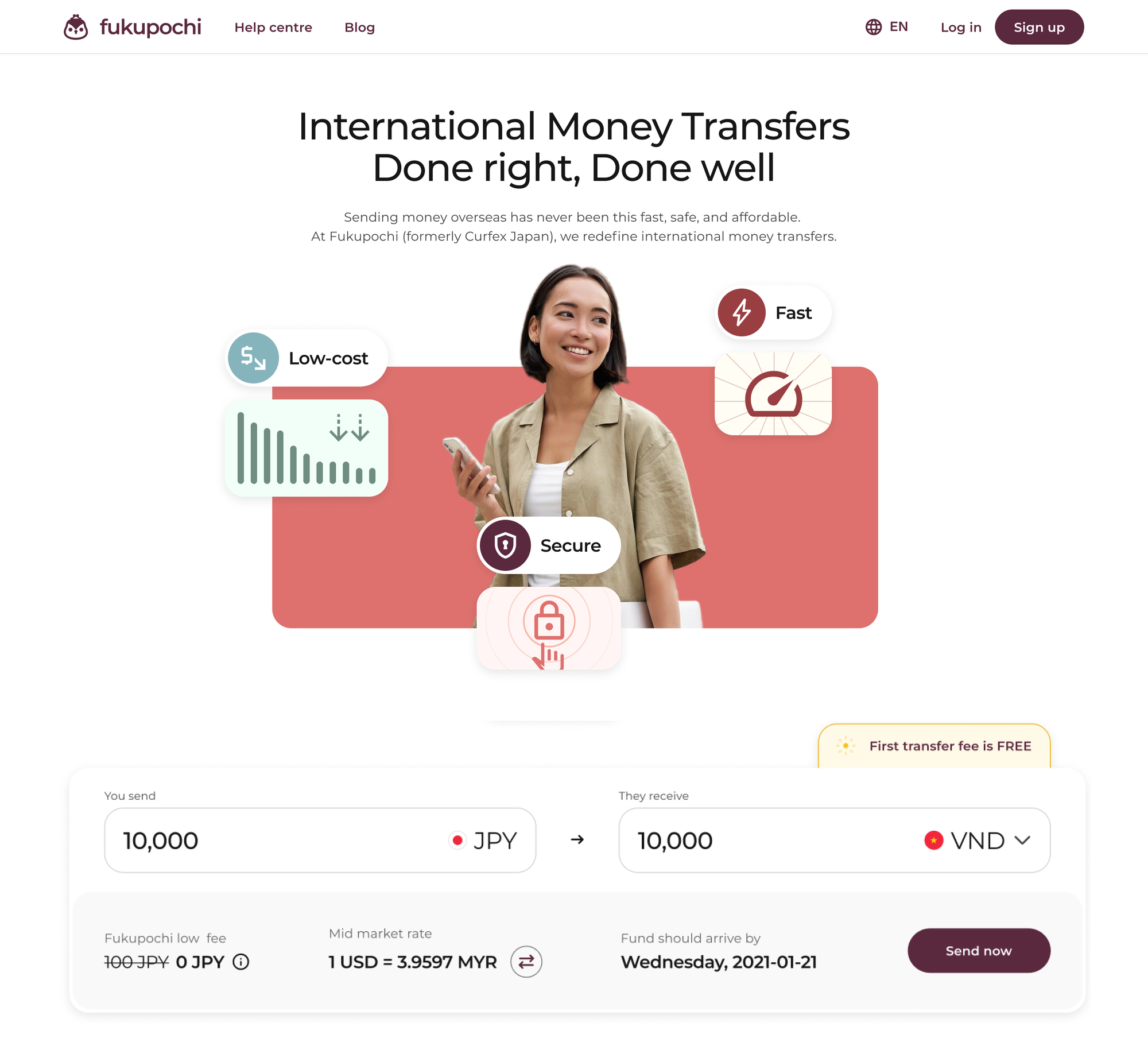
In addition, Fukupochi is also characterized by the lowest fees for money transfers in the industry.

With Fukupochi, there are no relay bank charges, which occur with bank transfers. While most banks add their own exchange fees to the actual exchange rate for remittances, Fukupochi uses the actual exchange rate without adding any unnecessary fees.

Fees charged with Fukupochi

Fees charged with bank transfers

(For Sumitomo Mitsui Banking Corporation)

Remittance fee:

1% of the amount exchanged


*No fees on first transaction only

Remittance fee: 3000 yen

*3,500 yen for remittance to other banks


Relay bank fees: 2,500 yen


Receiving fee:

Set by the receiving bank


On top of that, Fukupochi is currently offering a fee waiver campaign for the first transfer.

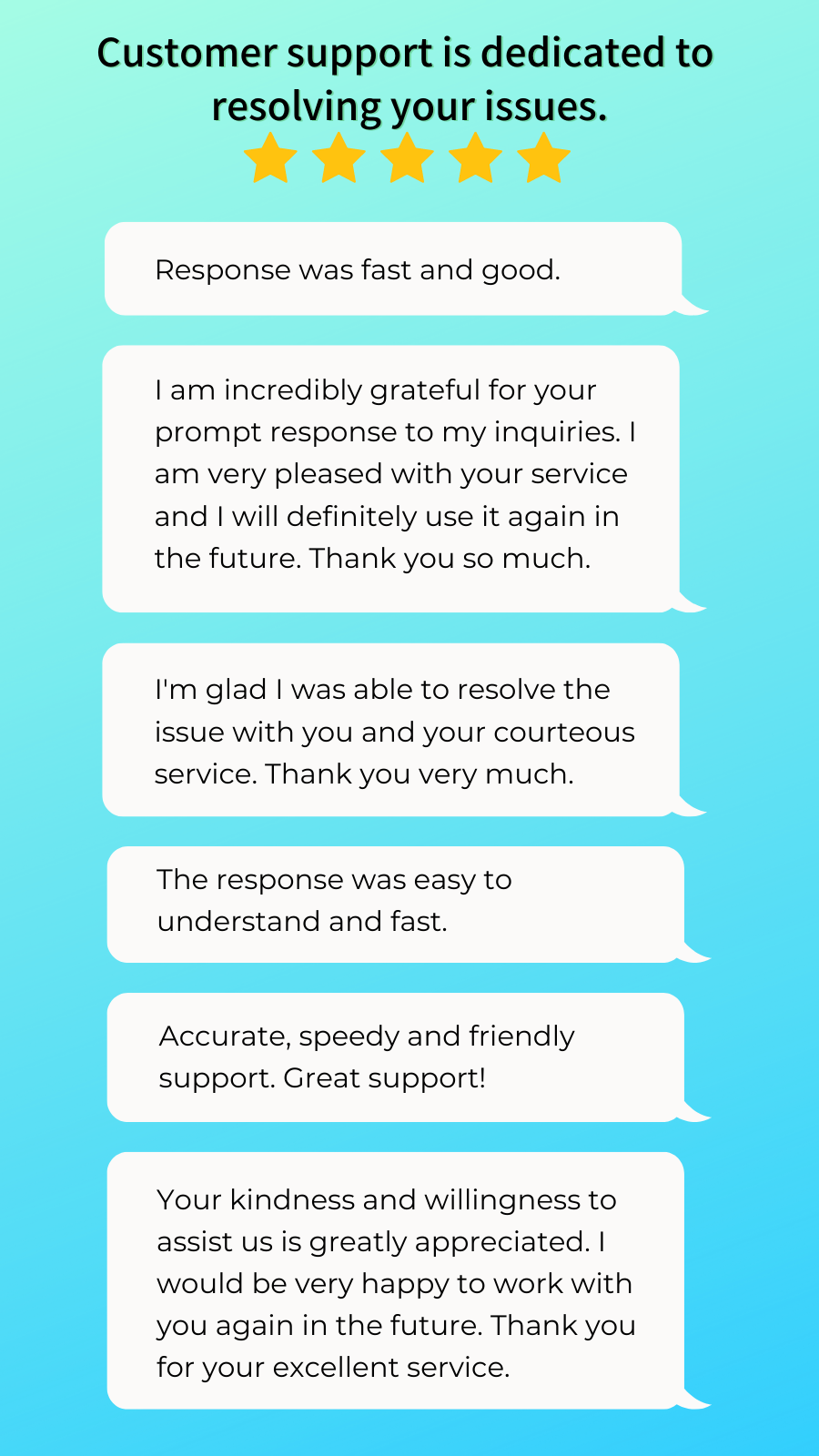
Our commitment to delivering exceptional service sets us apart from the competition and ensures that our customers have a positive experience every time they use our service. Whether you have a question about fees, exchange rates, or anything else related to your money transfer, our team is here to help. We are dedicated to making your money transfer process as smooth and stress-free as possible, and we are always happy to assist with any concerns or issues you may have. So if you're looking for a reliable and customer-focused money transfer service, look no further than us!
If you are considering or have plans to send money overseas, don't miss this chance and sign up with Fukupochi!

https://www.fukupochi.co.jp

References:
https://www.nta.go.jp/law/tsutatsu/kihon/shohi/06/05.htm
https://grancers-group.com/articles/countries_to_send_08
https://www.nta.go.jp/taxes/shiraberu/taxanswer/zoyo/4405.htm
https://www.nta.go.jp/taxes/tetsuzuki/shinsei/annai/gensen/kokugai/index.htm
What is the Best International Money Transfer Service From Japan to Use for Studying Abroad or Traveling? Comparing Banks and Money Transfer Services
2026-03-10  |  Fukupochi (Formerly Curfex Japan)

When studying or traveling abroad, access to foreign currency is one of the most essential items, be it paying a part of travel expenses to a local hotel or travel agency in advance, or preparing living expenses when for a short study or live abroad stint.

Without knowledge or experience of international money transfer, it may be hard to know what to do, or where to find the best service for sending money internationally.

In this article, we will discuss various methods of international money transfer, how to choose a service, and the best method by destination country, useful knowledge for those planning to study or travel abroad.

The Key Factors: Fees, Speed, and Convenience

While banks have long been the mainstream method of international money transfer, online services have also grown significantly in popularity.

The most suitable service will depend on the priority of the following three factors; fees, speed, and convenience.

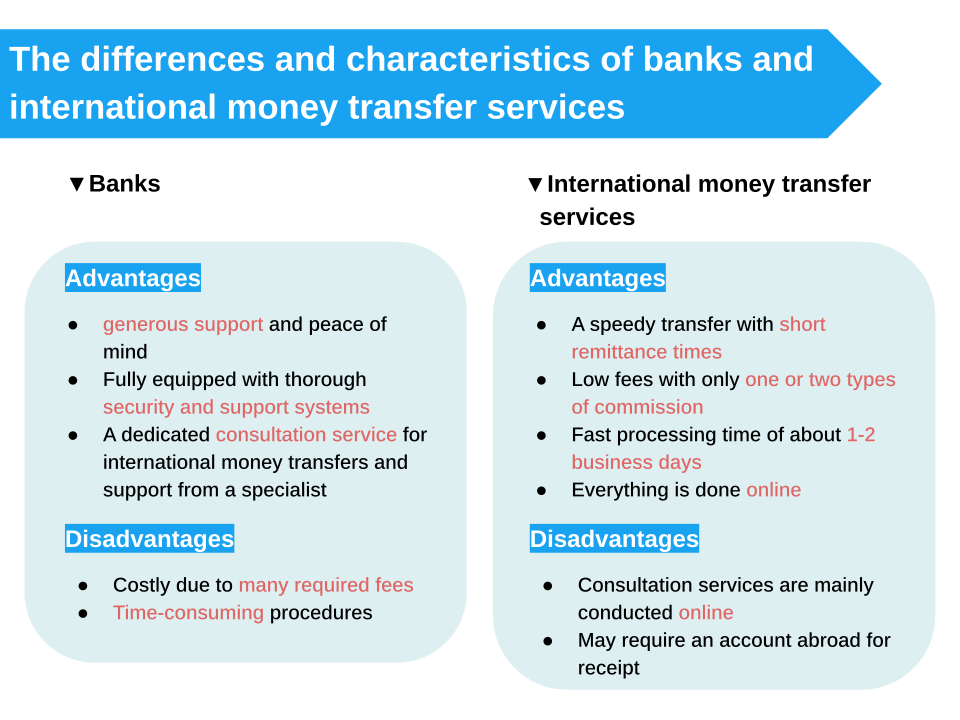
For example, if receiving help and support is a priority, a bank will be the best option as they have a helpdesk.

On the other hand, those who wish to reduce the fees for international money transfers as much as possible, or those wanting to complete transactions speedily, should opt for an international money transfer service as they offer speedy transactions at lower prices.

Why are there such differences in fees and speed between banks and international money transfer services? Let's take a more in-depth look at the differences and characteristics of each method.

Banks: Recommended for Those Prioritizing Support Rather than Fees and Speed

Are you not so particular about the fees and speed, and prefer to receive support when doing international transfers?

In that case, we recommend international money transfer services offered by a bank or a major financial institution.

Banks, as credit institutions, are fully equipped with thorough security and support systems and can provide tailored support depending on what kind of procedure needed.

In most cases, there is a dedicated consultation service for international money transfers. Immediate support from a specialist is available for any questions or concerns about the procedures involved.

Of course, international money transfer services also have a customer service center, but these are often only limited to online communication.

Therefore, for more generous support and peace of mind, transferring money through a bank is the most suitable option.

On the other hand, to keep the fees low or complete the transfer procedure in a short period, we recommend using an online international money transfer service.

Let's take a look at the differences in the fees charged for money transfers by banks and international money transfer services.

Fees charged when transferring money via a bank

  • Remittance fee: Fee charged by the bank where the remittance is made
  • Receiving fee: Fee charged by the bank where the money is received
  • Relay bank charges: Fees incurred by the relay bank before reaching the receiving bank
  • Foreign exchange commission: Commission incurred when exchanging currency using the bank's own exchange rate

The overall cost tends to be higher with money transfers through banks, as many relay banks are involved in the process. There are many types of fees, such as a remittance fee by the Japanese bank, a foreign exchange commission when the bank exchanges currencies at its own rate, fees charged by relay bank(s), and a receiving fee by the bank in the destination country.

Do note that depending on the country and the route, there may be more than one relay bank, each of which will charge a separate fee.

Fees charged when transferring money via an international money transfer service

  • Remittance fee: Fee charged when sending money from an international money transfer service
  • Foreign exchange commission: (There are two types of services: those that charge a commission by using their own exchange rate, and those that use the actual exchange rate and charge no commission.)

Since international money transfer services do not use banks for transactions, only two types of fees are incurred: a remittance fee and a foreign exchange commission.

In addition, there are also two types services in terms of foreign exchange commission: those that use the "mid-market rate," which is the actual exchange rate, and those that use their own exchange rate with a commission added on top of the exchange rate.

To keep fees low, always check if the offered rate only includes essential fees, or if there are additional fees on top of the exchange rate, before choosing a service.

There is also a difference in the speed between banks and international money transfer services. Since bank transfers involve many financial institutions, it usually takes about 5 to 7 business days to complete a transaction. On the other hand, international money transfer services do not use relay banks, allowing speedy transactions that take only 1 to 2 business days.

Based on the given points, international money transfer services are better options for those seeking a lower fee and a speedy transfer.


Procedures with banks

Procedures with international money transfer services

Types of fees incurred

Remittance fees, relay bank fees, receiving fees, foreign exchange fees (with additional fees)

Remittance and foreign exchange fees (additional charges may or may not be incurred)

Duration

Approx. 5 to 7 business days

Approx. 1 to 2 business days


Depending on the destination country, the available services, fees, and duration may differ slightly. In this section, we will introduce recommended services for the three most popular destinations – South Korea, the United States, and Thailand – and compare each with the other.

Money Transfers to South Korea

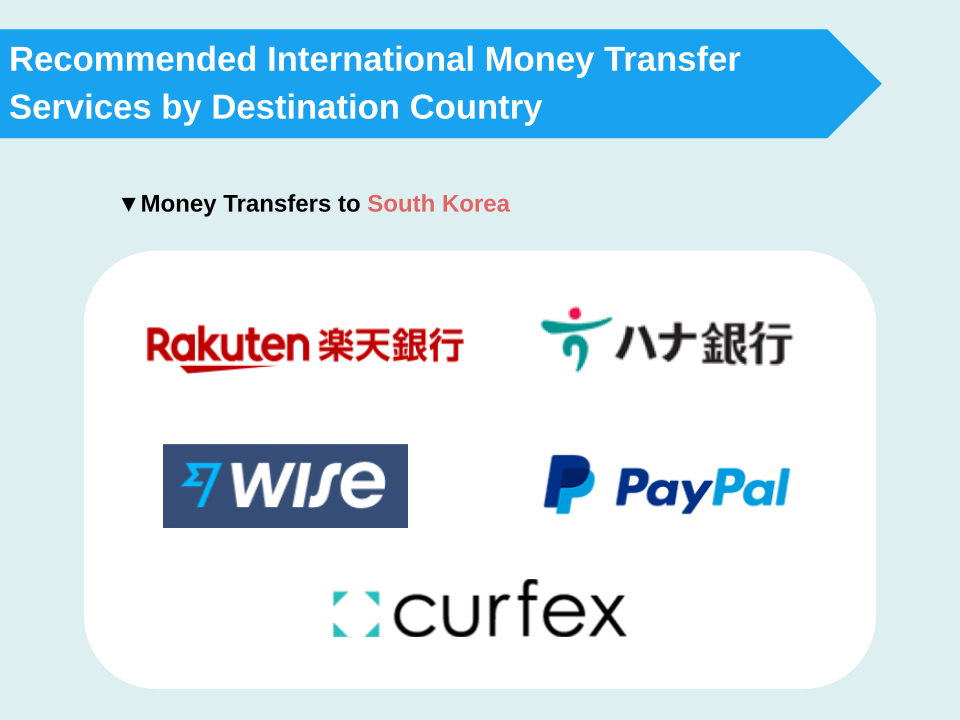
When sending money to South Korea, international money transfers through Hana Bank, a Korean bank, are more popular than the ones using Japanese banks. Hana Bank is a major bank with users and branches in Japan, so it may be a good idea for those who frequently transfer money to South Korea to open an account with Hana Bank for convenience.

Rakuten Bank also offers a relatively low handling fee compared to the megabanks, making it one of the more affordable options.

In terms of money transfer services, Wise and Fukupochi offer low fees and speedy transfers, making it convenient for those who want to transfer money quickly. PayPal is also commonly used not only for international money transfers but also for payments at stores worldwide. For those already with an account, it is another easy option.

On the other hand, Paypal also has drawbacks, such as taking a longer time than other money transfer services and charging higher fees than Wise and Fukupochi since it uses its own exchange rate, which adds a fee on top of the mid-market rate.

Service

Fees

Duration

Rakuten Bank

Remittance fee: 750 yen


Relay bank fee: 1,000 yen


Receiving fee: Determined by the receiving bank

1-3 business days

Hana Bank

Remittance fee:

Up to 100K yen: 2,000 yen

Up to 1M yen: 3,000 yen

Up to 2M yen: 4,000 yen


Receiving fee:

Determined by the receiving bank

2 to 4 business days

*When using an automatic remittance card, the transaction will be performed by the next business day.

Wise

Remittance fee:

A flat fee of 192 yen + 1.03% of the amount that's converted

*Some remittance fees have increased, so there may be an additional amount.

Same day to next business day

Paypal

Remittance fee: 499 yen

*A hidden fee is charged as it adds approx. 4% of exchange commission to the exchange rate.

About 3 business days

Fukupochi

Remittance fee:

1% of the amount exchanged


A fee of 1,000 yen for 100,000 yen

Same day to next business day


Click here to read more about sending money to Korea

Money Transfers to the U.S.

The United States is one of the most popular destinations to send money, so it is safe to assume that almost all banks and international money transfer services support money transfers there. While there are many options, we recommend the following methods and services.

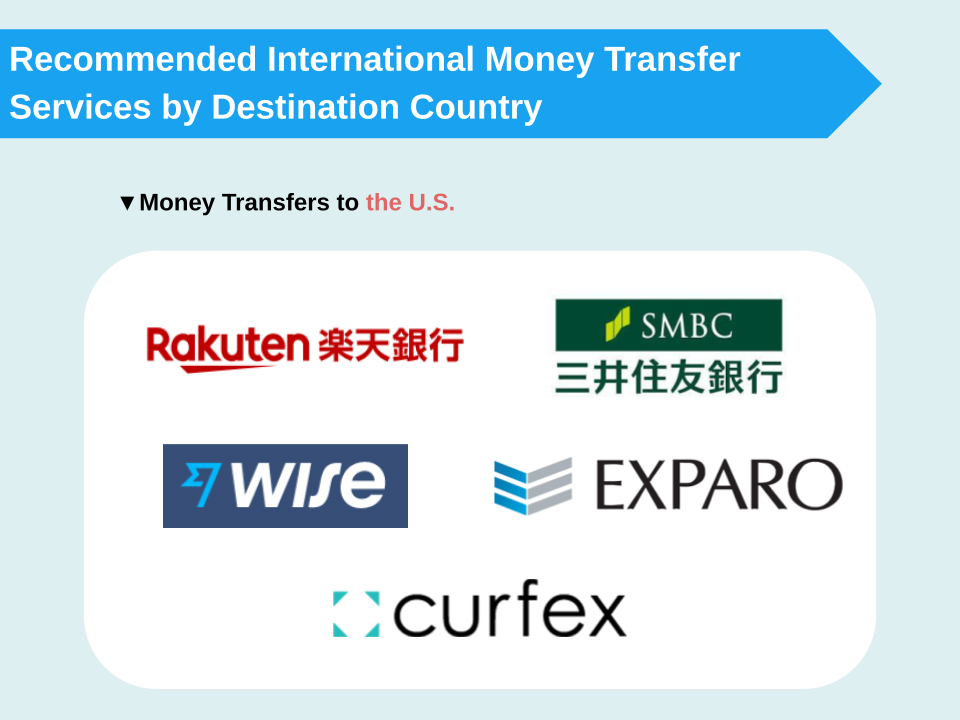
Rakuten Bank is recommended for those who want to perform the transfer through a bank. The fees are relatively low and it does not require many days to complete a transaction.

Sumitomo Mitsui Banking Corporation is also a highly reliable megabank in Japan, so it can be recommended to those who would like to use the consultation service in case of any problems.

Wise, Exparo, and Fukupochi are convenient international money transfer services that can complete the procedure smoothly even if the destination country is as far away from Japan as the United States.

However, do note that Wise has recently increased some of its fees, so it is recommended to check if there is an additional fee added on top of the mid-market rate.

Exparo also uses its own exchange rates, which may translate to hidden fees.

Fukupochi is a service that allows trading at mid-market rate, which means no hidden fees and maximum commission savings.

Service

Commission

Duration

Rakuten Bank

Remittance fee: 750 yen


Relay bank fee: 1,000 yen


Receiving fee:

Set by the receiving bank

About 3 to 5 business days

Sumitomo Mitsui Banking Corporation

Remittance fee: 3000 yen for remittance to overseas branches, 3,500 yen for remittance to other banks


Relay bank fee: 2,500 yen


Receiving fee:

Set by the receiving bank

5 to 7 business days

Wise

Remittance fee:

A flat fee of 89 yen + 0.75% of the amount that's converted

*Some remittance fees have increased, so there may be an additional amount.

Same day to next business day

Exparo

Remittance fee:

Up to 100,000 yen: 2,500 yen

Up to 1 million yen: 3,500 yen

*Hidden fees are incurred as it uses its own exchange rate.

1 to 4 business days

Fukupochi

Remittance fee:

1% of the amount exchanged


A fee of 1,000 yen for 100,000 yen

Same day to next business day


Read more about sending money to the U.S. here.

Money Transfers to Thailand

Thailand is a popular destination for international money transfer, mainly for business trips and tourism.

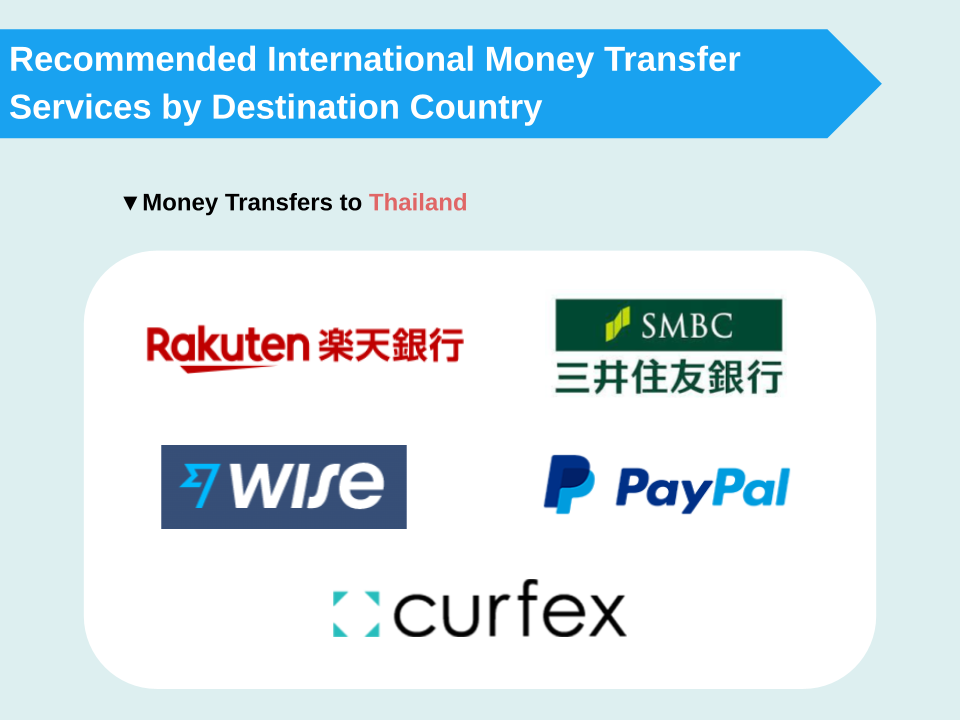
Sumitomo Mitsui Banking Corporation is a highly reliable megabank among the many financial institutions and international money transfer services that support transfers to Thailand, but the transactions take quite a long time and incur high fees. For transfers through a bank that save a little more money and time, Rakuten Bank is the recommended option.

If low cost and speed are priorities, using an international money transfer service is by far the best choice.

Wise, Paypal, and Fukupochi are the three services listed here, but if speed is the priority, we recommend Wise or Fukupochi as they can process the transaction by the next business day.

If cost is of concern, Fukupochi is the best option as it uses the mid-market rate rather than its own exchange rate and clearly states that there are no added fees.

Service 

Commission

Duration

Rakuten Bank

Remittance fee: 750 yen


Relay bank fee: 1,000 yen


Receiving fee:

Set by the receiving bank

About 3 to 5 business days

Sumitomo Mitsui Banking Corporation

Remittance fee” 3000 yen

3,500 yen for remittance to other banks instead of overseas branches


Relay bank fee: 2,500 yen


Receiving fee:

Set by the receiving bank

About 7 business days

Wise.

Remittance fee:

A flat fee of 164 yen + 0.88% of the amount that's converted

*Some remittance fees have increased, so there may be an additional amount.

Same day to next business day

Paypal

Remittance fee: 499 yen

*A hidden fee is charged as it adds approx. 4% of exchange commission to the exchange rate.

3 to 6 business  days

Fukupochi

Remittance fee:

1% of the amount exchanged


A fee of 1,000 yen for 100,000 yen

Same day to next business day


For Speedy Money Transfers at a Low Cost, go with Fukupochi (formerly Curfex Japan)!

In this article, we have looked at the features of different international money transfer services and how to choose one.

For eisure or business trips, as well as studying abroad, international money transfer is an essential process. It is important learn the basics and even complete any sign up or registration processes in advance, as the identification process may take a while.

Speed and fees are the key points when it comes to choosing an international money transfer service. To keep the fees as low as possible and perform the transfer speedily, Fukupochi offers the best of both worlds.

Fukupochi only charges a 1% fee on the amount transferred, and the exchange rate is based on the mid-market rate, which means there is no need to worry about added fees.

To sweeten the deal, Fukupochi is currently offering a free first transfer. If you have plans to go abroad sometime soon, do register now and take advantage of the promotion.

Our commitment to delivering exceptional service sets us apart from the competition and ensures that our customers have a positive experience every time they use our service. Whether you have a question about fees, exchange rates, or anything else related to your money transfer, our team is here to help. We are dedicated to making your money transfer process as smooth and stress-free as possible, and we are always happy to assist with any concerns or issues you may have. So if you're looking for a reliable and customer-focused money transfer service, look no further than us!

Take this opportunity to register with Fukupochi and enjoy your stay abroad with great savings!

https://www.fukupochi.co.jp

Comparing International Money Transfer Services: What’s the Best Service to Transfer Money to South Korea?

2026-03-10  |  Fukupochi (Formerly Curfex Japan)

Sending money to a foreign country is an essential skill needed when studying or living abroad, or when payments need to be made to a company or school located abroad.

Unlike domestic funds transfers within Japan, not many know how international money transfers actually work.

In this article, we will discuss the mechanism of international money transfer, its methods, and recommended means for transferring money from Japan to South Korea, while comparing various services.

Things to Know When Sending Money to South Korea

International money transfer refers to the act of sending money from a Japanese bank account to an overseas bank account. While some people may think of taking cash with them when they travel to South Korea due to its proximity to Japan, it is not recommended as there is a high risk of theft. Instead, you can send money abroad using international money transfer services.

Here are some situations where you may need to transfer money from Japan to South Korea:

  • Studying abroad in South Korea
  • Paying tuition from Japan to a language school in South Korea
  • Moving to South Korea for work, or sending money to a family member working in South Korea
  • Paying for products from South Korean companies
  • Paying an advance deposit for receiving treatment at a cosmetic clinic
  • Sending advance payment for a K-pop concert ticket

When sending money to South Korea, it is important to know about the international money transfer system and how it works.

There are two means of international transfers; banks and international money transfer services.

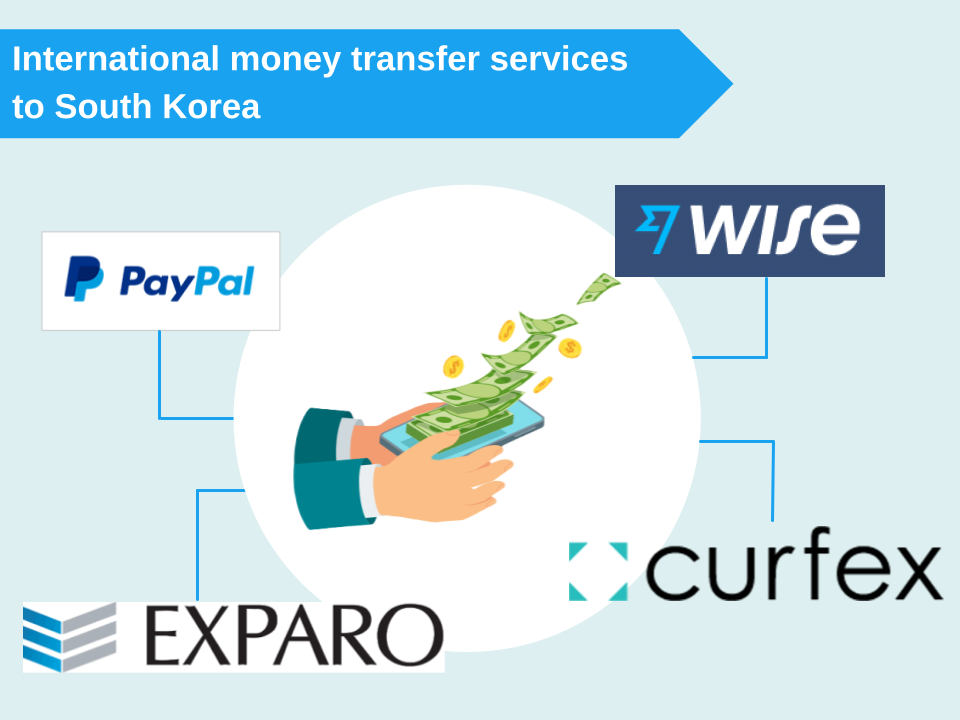
Banks vary in type, and includes both major banks and online banks. For international money transfer services, there is a large number of companies on the rise, with Paypal, Wise, Exparo, and Fukupochi being a few that provide money transfer services to South Korea.


The basic steps for a money transfer are as follows:

  1. The user decides on the amount to be transferred at a Japanese financial institution and goes through the procedures
  2. The financial institution exchanges the money into the local currency of the destination country
  3. If the financial institution is a bank, the transfer is processed through an intermediary bank before being sent to the receiving bank
  4. The user receives the money from the designated receiving bank account

Note that the time required to complete the procedures differs between banks and international money transfer services.

Bank transfers to South Korea takes about one week from the time of request to the completion of the transfer, while money transfer services can often complete it in just one to two days.

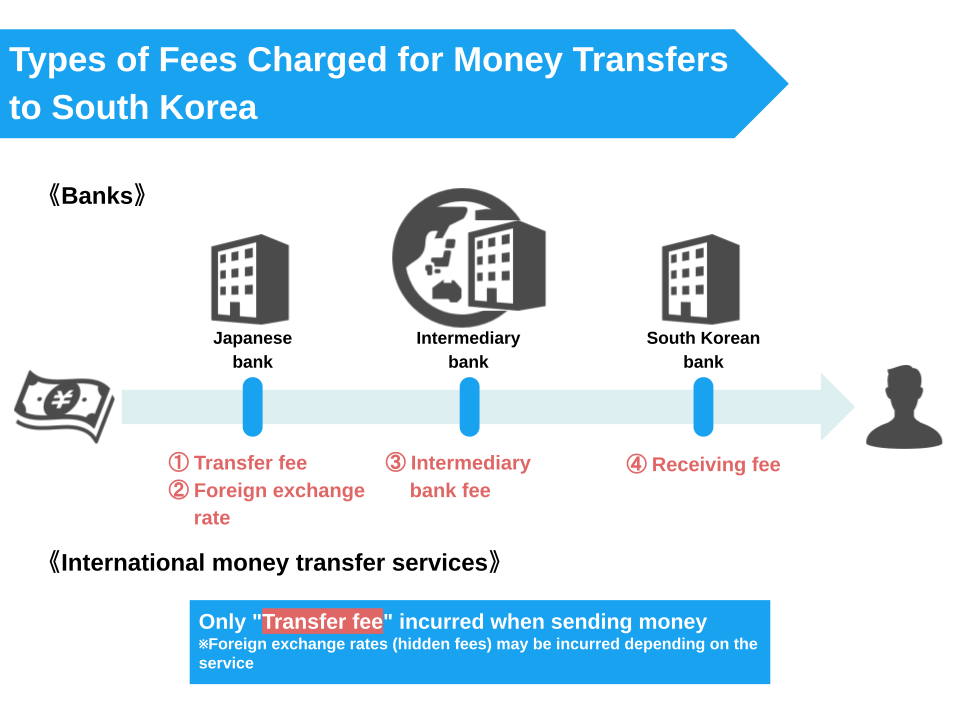
Types of Fees Charged for Money Transfers to South Korea

So what are the fees incurred when sending money to South Korea?

The type of fees and amount will vary depending on whether you use a bank or an international money transfer service.

Banks

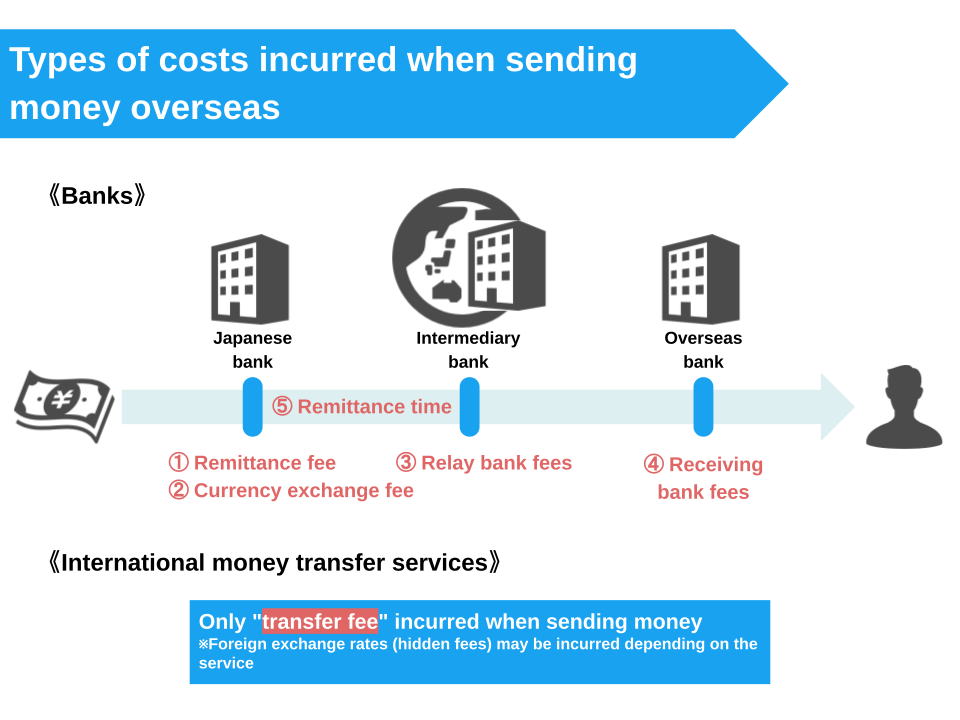
  • Transfer fee: Fee charged by the Japanese bank at the time of transfer
  • Receiving fee: Fee charged by the South Korean bank upon receipt
  • Intermediary bank fee: Fee charged by the intermediary bank
  • Foreign exchange rate: Commission incurred when exchanging currency using the bank's exchange rate


International money transfer services

  • Transfer fee: Fee charged when sending money through an international money transfer service
  • Foreign exchange rates (hidden fees) may be incurred depending on the service

At a glance, it is clear that bank transfers to South Korea are relayed by many institutions, which in turn can incur many types of fees.

On the other hand, money transfer services can complete a transfer with a single transfer fee.


Banks

International money transfer services

Transfer fee

Required

Required

Receiving fee

Required

Not required

Intermediary bank fee

Required

Not required

Foreign exchange rate

Required

Depends on the service

Duration of completion

5-7 days

1-2 days


Note: Commissions may be hidden in the exchange rate

It is important to note that in some cases, commissions are hidden in the exchange rate.

Banks and international money transfer services offer different exchange rates. Despite claiming zero fees, some money transfer services take advantage of the ever-changing exchange rate and charge hidden commissions by changing the amount accordingly.

To avoid losing money due to these hidden fees, we recommend that you check both the exchange rate commission and transfer fee to make sure there are no hidden fees.

A good sign is if the service uses the mid-market rate, which is an intermediate rate of buy and sell prices, rather than the bank or company's own rate. In these cases, there is no need to worry about being overcharged.

As mentioned earlier, we recommend using an international money transfer service because the fees are lower and the procedure itself can be completed quickly.

In this section, we will look at some recommended international money transfer services that can be used to send money from Japan to South Korea.

International Money Transfer Services from Japan to South Korea: Paypal

Paypal is a service that allows online payments at more than 2,400 commercial stores worldwide, as well as money transfers between individuals. It also offers an international money transfer service spanning 190 countries in 23 currencies. It is an easy option for those who already utilize the service for online payments since they can use the same app.

Fees for Money Transfers to South Korea

Paypal is one of the most popular money transfer services adopted by many commercial establishments, making it widely used by people around the world.

It can be an easy starting option for those who already use the service, even if they have no experience in international money transfers.

Unfortunately, Paypal currently does not support international money transfers to South Korea.

While many other countries allow money transfers via Paypal, money transfers to South Korea are not supported as of 2022. If you want to send money to South Korea, you cannot use Paypal.

It is common for users to assume that a global service like Paypal will offer money transfers to South Korea, so it is important to check in advance whether the service is supported in your destination country.

See: https://developer.paypal.com/api/rest/reference/currency-codes/

International Money Transfer Services from Japan to South Korea: Wise


Wise is an international money transfer service based in the UK. Its domestic money transfer service allows users to send money quickly and at a low fee. It also supports money exchange into 53 currencies and transfers to 80 countries.

Another advantage of Wise is its app, which allows users to complete transfers on a smartphone without having to use a computer.

Fees for Money Transfers to South Korea

Wise charges a flat fee of 192 yen and 1.03% of the amount that's converted as a transfer commission when transferring money to South Korea.

Since its official website clearly states that they do not charge any hidden fees, there is no need to worry about extra fees.

Exchange Rate for transfers to South Korea

Wise uses the mid-market rate and clearly states that the transactions are at a fair rate.

Duration of Completion

Transactions between major currencies can be handled typically in the same day to one business day.

International Money Transfer Services from Japan to South Korea: Exparo


Exparo is an international money transfer service located in South Korea that specializes in money transfers to South Korea.

Many users find this service reliable as they can use a South Korean company to send money to South Korea.

Fees for Money Transfers to South Korea

The transfer fee is set at 2,500 yen per transfer of 100,000 yen or less, and 3,500 yen for transfers of 100,000 yen to 1,000,000 yen.

Exchange Rate for Transfers to South Korea

Since Exparo uses its own exchange rate, there is a possibility that you will be charged an additional fee. You may want to check in advance how much the total amount will be when the foreign exchange rate and transfer fee are combined.

Duration of Completion

With Exparo, a transaction can be handled typically within one day, though it can take two to four days until money is received on the other end.

International Money Transfer Services from Japan to South Korea: oneremit


oneremit is an international money transfer service operated by C&B Corporation, also known as Hana Money Transfer. You can send money to South Korea, Vietnam, Nepal, and the Philippines.

Fees for Money Transfers to South Korea

The transfer fee is 500 yen for transfers of 50,000 yen or less, and 1,000 yen for those of 50,000 yen to 1,000,000 yen.

Exchange Rate for Transfers to South Korea

oneremit has their own exchange rates and tops 0.05 yen to 0.5 yen above the KEB Hana Bank South Korea exchange rate at the time of transaction. You may want to check in advance how much the total amount will be when the foreign exchange rate and transfer fee are combined.

Duration of Completion

Transfers are usually handled on the day of request. The receipt in South Korea can be made on the same day, while in other countries, it can be made on the following day or later.

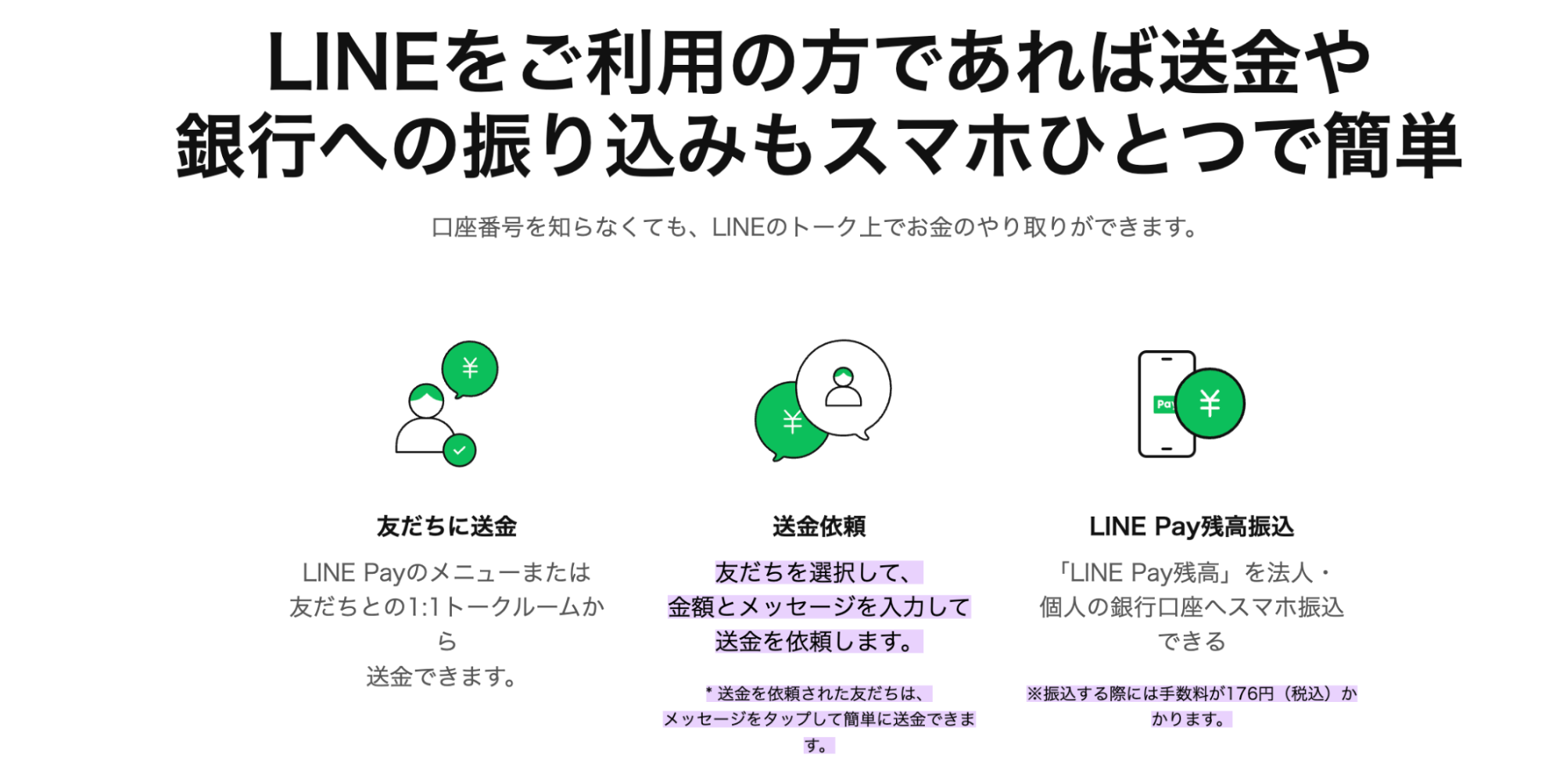
International Money Transfer Services from Japan to South Korea: LINEPay

LINEPay is operated by LINE, the most popular communication application in Japan. It does not have an established international money transfer service, but its foreign currency exchange service allows money transfers between individuals.

Fees for Money Transfers to South Korea

LINEPay allows users to send money freely to other users as long as they both have the app, with a fee of 176 yen for a smartphone transfer to a personal bank account.

LINE Pay transfer method

Exchange Rate for Transfers to South Korea

The exchange rate to South Korean Won is not based on the mid-market rate, but is multiplied by 3% of the amount exchanged.

It is advised to check in advance how much the total cost will be with the exchange rate added.

Duration of Completion

The transactions with LINEPay are estimated to take 3 to 5 days from request to receipt.

International Money Transfer Services from Japan to South Korea: Fukupochi (formerly Curfex Japan)


Fukupochi is an international money transfer service that allows money transfers to 46 countries, mainly South Korea and the United States. It is approved by the Financial Services Agency and is highly reliable, with an established reputation for low fees and quick transfers.

In addition, because it specializes in international money transfers, the registration and transfer processes are simple and easy, making it suitable for beginners.

Fees for Money Transfers to South Korea

The transfer fee is set at a flat rate of 1%. It is not affected by the transferring amount or exchange rate, so there is no need to worry about paying an unexpected extra amount.

Exchange Rate for Transfers to South Korea (Mid-Market Rate)

Since it uses the mid-market rate for its exchange rates, there is no need to worry about paying additional fees. This means no foreign exchange rate is charged when transferring money with Fukupochi.

Duration of Completion

Transactions are typically handled on the day of request, and it takes about a day to be received, which is quicker than other services.

Summary – Comparison of Money Transfer Services to South Korea

Finally, the table below shows a summary of the services we compared in this article.


Fukupochi

Wise

Exparo

oneremit

LINEPay

Transfer fee

0% commission for the first transfer

flat fee of 192 yen + 1.03% of the amount that's converted

2,500 yen for transfers of 100,000 yen or less


3,500 yen for transfers from 100,000 yen to 1,000,000 yen

500 yen for transfers of 50,000 yen or less


1,000 yen for transfers from 50,000 yen to 1,000,000 yen

176 yen

(When sending money from a smartphone to a bank account)

Foreign Exchange Rate

0 yen

0 yen

Depends on Exparo’s internal rate

Depends on the rate, charges an additional 0.05 to 0.5 yen

3% of the exchanged amount

Receiving Amount per Transfer of 100,000 yen

970,313 KRW

960,657 KRW

934,420 KRW

950,617 KRW

Unknown

(International bank receipt unavailable)


Source:

Fukupochi: Fukupochi
Paypal: Usage Fees|PayPal (PayPal) for individuals
Wise: Wise Fees for Sending Money, Wise Fees & Pricing: Only Pay for What You Use
exparo: List of fees and service charges|Information
oneremit: We will send you our sincere appreciation for your business. Hana transfer■ C&B Inc.
LINEPay: LINE Pay money transfer method


Fukupochi is the Best Service for Money Transfers to South Korea

When sending money from Japan to South Korea, we recommend using an international money transfer service rather than a bank. Fukupochi and Wise use the mid-market rate and have no hidden fees, which allows users to keep the cost low. Fukupochi, in particular, has a very low transfer fee of 1%, making it the most recommended international money transfer service.

In addition to having official approval from the FSA, it allows users to send money quickly at a low cost, usually within one to two days.

At our money transfer service, we pride ourselves on providing the best customer service in the industry.

Our commitment to delivering exceptional service sets us apart from the competition and ensures that our customers have a positive experience every time they use our service. Whether you have a question about fees, exchange rates, or anything else related to your money transfer, our team is here to help. We are dedicated to making your money transfer process as smooth and stress-free as possible, and we are always happy to assist with any concerns or issues you may have. So if you're looking for a reliable and customer-focused money transfer service, look no further than us!

The service currently offers a free first transfer, so if you are considering sending money to South Korea, try out Fukupochi!


https://www.fukupochi.co.jp

Money Transfers From Japan to the U.S.: Basic Knowledge and Companies Offering the Service

2026-03-10  |  Fukupochi (Formerly Curfex Japan)

Do you have plans to stay in the U.S. for a long period to study or on a business trip? In that case, you may need to find an international money transfer service to send money over from Japan. There are several options available on the market, with varying transfer times and costs depending on the method you choose.

This article will share some basic must-know information, focusing on the various types of money transfer services and the fees charged when sending money from Japan to the U.S.

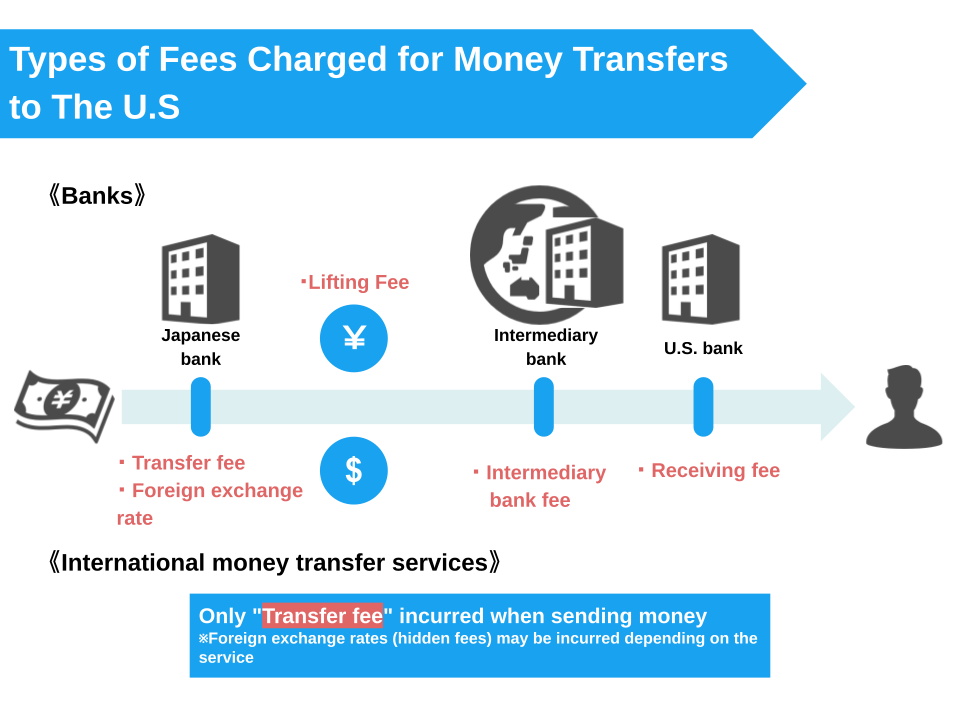
Types of Fees Charged When Sending Money to the U.S.

Multiple types of fees can be charged when sending money to the United States. In this section, we will look at them one by one in detail.

1. Transfer Fee

A transfer fee is charged by the Japanese bank (remitting bank) when sending money to the United States from Japan. The amount varies depending on the bank and service, as well as the country you are sending money to, so it is recommended to confirm this in advance.

2. Receiving Fee

A receiving fee is charged by the U.S. bank (receiving bank) that receives the money sent to the U.S. The amount varies from bank to bank, which is a good thing to check out in advance. Do note that the receiving fee is only charged with money transfers through a bank.

3. Intermediary Bank Fees

When you send money from Japan to the U.S., the bank that acts as an intermediary between the Japanese and U.S. banks will charge a correspondent bank fee. The intermediary bank is called a correspondent bank, which is essential when the source country and destination country do not have a "correspondent agreement", making it impossible to send money directly. Fortunately, Japan and the U.S. have a correspondent agreement in place, so it is possible to relay money to the U.S.

Different banks may link up with multiple intermediary banks. If this is the case, the overall fee may be higher as each bank involved will charge a separate fee. Thus, it is wise to choose a service that involves as few intermediary banks as possible to reduce the commission. Do also note that intermediary bank fees are only charged with money transfers through a bank.

4. Foreign Exchange Fee

Foreign exchange fees are included in the exchange rate each bank sets on its own. When sending money from Japan to the U.S., the fee is incurred when the currency is exchanged from yen to dollars.

Here is a more in-depth explanation of foreign exchange commissions.

Imagine sending $100 from Japan to the U.S. If the bank’s own exchange rate is 116 yen per dollar when the actual rate is 115 yen per dollar, how much will the exchange commission be?

The actual exchange rate for $100 is 11500 yen, but at the bank's rate, it costs 11600 yen to send $100, so the difference of 100 yen is taken as an exchange commission. In short, the closer the difference between the actual exchange rate and the bank rate is to zero, the lower the commission fee will be.

Exchange rates fluctuate depending on the amount of demand for each currency, so it is recommended to always check the exchange rate before sending any money. Do note that some money transfer services do not charge an exchange commission.

5. Lifting Fee

A lifting fee is charged when transferring money without exchanging currency. The lifting fee is always applied when sending money in yen to another country. On the other hand, many banks do not charge the lifting fee when transfering foreign currency into a foreign currency deposit account as it is. The reason for this is that when a deposit is made into a foreign currency deposit account, the exchange procedure is performed at a rate that already includes exchange fees.

Although it might seem like an option that allows one to save on fees, this lifting fee may result in higher fees in some cases. Unless there is a reason to send and keep money in yen, this method is not recommended.

How Long Do Money Transfers to the U.S. Take?

Bank Transfers

In most cases, it takes about 5 to 7 business days to complete a money transfer to the U.S. If the money is sent through a bank, the transaction will be conducted via a correspondent bank based on the correspondent agreement mentioned above. Some banks may utilize multiple intermediary banks, which will increase the time taken for the transaction process.

Money Transfer Services

Money transfer services typically take 1-2 business days to complete a money transfer to the U.S. These services can perform transactions quicker than banks as there are no intermediaries such as relay banks or receiving banks, which are unique to bank transfers.

#1: Banks

When money is sent from a bank to the U.S., the transaction involves the source bank, the receiving bank, and any intermediary banks (correspondent banks). When the source bank sends money to another country, the remittance message is transmitted through the international banking network known as SWIFT, and the remittance exchange proceeds. In other words, remittances cannot be exchanged in countries that are not in the SWIFT network.

Therefore, it takes a longer time for the transfer to be completed as it is processed through various agencies and banks.

#2: Money Transfer Service – PayPal

PayPal is a money transfer service that supports remittances to 190 countries in 23 currencies and is also compatible with online payments at commercial facilities.

The remittance fee is inexpensive at 499 yen per transaction. However, PayPal uses its own exchange rate, which means there is a "hidden fee" where a currency conversion fee is added on top of the actual exchange rate. A transaction through PayPal usually takes about 3 business days.

The currency conversion fee is charged when a transaction is made in a different currency from the source currency. Paypal requires the sender to pay 4% and the receiver to pay 3% of the transaction if the money is sent in Japanese yen and received in U.S. dollars.

#3: Money Transfer Service – Wise (formerly Transferwise)

Wise is a money transfer service that supports money transfers to 80 countries in 53 currencies. It has a reputation for being user-friendly, as transactions can be performed easily on their app.

The remittance fee to the U.S. is set at 0.75% of the amount converted and a flat fee of 89 yen, and there are no hidden fees as the exchange rate is based on the mid-market rate. A transaction through Wise usually takes about 1 to 2 business days.

However, Wise's remittance fee has been raised recently, so do check it out to confirm the new fees before using the service.

Source: https://wise.com/price-change/send-money

#4: Money Transfer Service – Fukupochi (formerly Curfex Japan)

Fukupochi is a money transfer service that supports money transfers to 46 countries, mainly the United States and South Korea. It is well known for its low fees and speedy service.

The remittance fee is set at 1% of the withdrawal amount, and there is no need to worry about hidden fees as it uses the mid-market rate. A transaction through Fukupochi can be completed within the day or in 2 business days at most.

Source: https://www.fukupochi.co.jp

The following table compares the various fees for these three international money transfer services.


Fukupochi

Wise

PayPal

Transfer fee

0% commission for the first transfer

A flat fee of 89 yen + 0.75% of the amount that's converted

499 yen

The currency conversion fee

0 yen

0 yen

4% of the exchanged amount

Receiving Amount per Transfer of 100,000 yen

727.20 USD

721.62 USD

694.62 USD

Is it Possible to Transfer Money to the U.S. by Check?

It is possible to send money to the United States by check. A check must be issued by a Japanese bank that specifically handles checks, which is then sent to the receiver in the U.S. via post, and the U.S. bank cashes the check.

However, it is important to note that fewer and fewer megabanks in Japan provide support for international money transfers via check. There is also a fee for issuing checks, and considering that the money can be lost if the check itself gets lost, this is not really a recommended method to send money.

Are there any taxes when sending money to the U.S.?

Will taxes be incurred when sending money to the U.S.? Whether the money transfer is made between individuals or not, the tax office will know that there has been a transaction. This is due to a regulation that requires banks to send a Foreign Remittance Report to the tax office when remittances of 1 million yen or more are made.

Therefore, remittances from abroad as part of an income are subject to taxation as income tax, regardless of the amount.

There is a misconception that the tax office will not be notified of remittances below 1 million yen, but that is not true. Even if the remittance amounts to less than 1 million yen and there is no obligation to submit a report, the tax office can choose to confirm the fact of the remittance and request a tax inspection. The filing of tax returns should be considered mandatory for money received through overseas remittances.

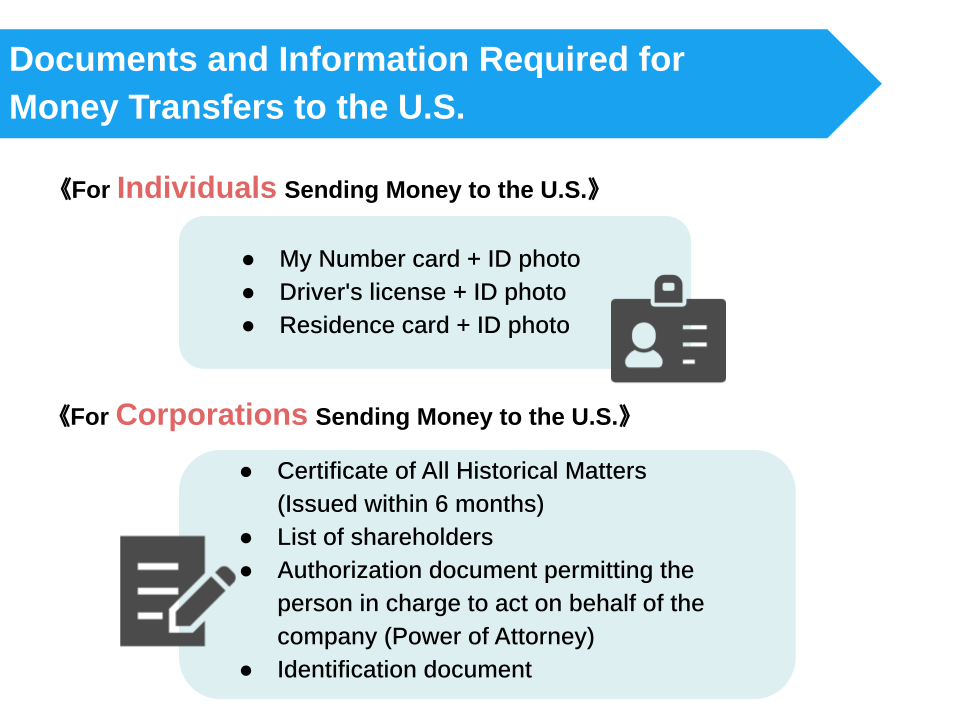
Documents Required for Money Transfers to the U.S.

When sending money to the U.S., there are certain documents and information that must be submitted. The information required varies depends on whether the money is sent by an individual or a corporation, and we will take a look into both in this section. There may be differences in the required documents depending on the bank or money transfer service, but we will focus on the documents required for money transfer services here.

Required Information for Individuals Sending Money to the U.S.

When making a personal remittance, all that is needed are identification documents. The most common way to submit these documents is through online verification. Users can complete the online certification process by submitting one of the following.

  • My Number card + ID photo
  • Driver's license + ID photo
  • Residence card + ID photo

Required Information for Corporations Sending Money to the U.S.

When making a corporate remittance, several documents listed below need to be submitted:

  • Certificate of All Historical Matters (issued within 6 months)
  • List of shareholders
  • Authorization document permitting the person in charge to act on behalf of the company (Power of Attorney)
  • Identification document

Any of the following can be used as an identification document:

  • My Number card + ID photo
  • Driver's license + ID photo
  • Residence card + ID photo

Once these documents have been submitted and reviewed, users can start sending money overseas.

Fukupochi is the Best Option for Money Transfers to the U.S.!

In this article, we have looked into the steps and procedures for money transfers to the United States.

Based on the points discussed, Fukupochi is the recommended international money transfer service when sending money to the U.S. Fukupochi is a highly reliable service that allows transactions to 46 countries and has been approved by the Financial Services Agency.

The best features of this service is that it charges only a 1% fee and uses the mid-market rate, which means there are no additional fees. Some services charge hidden fees by using their own exchange rate which adds an additional fee on top of the actual exchange rate. With Fukupochi, there is no need to worry about such hidden fees, and users can rest assured as all fees are shown clearly.

Fukupochi’s money transfer also takes between one to two days, making it an ideal option when money has to be sent in a hurry.

In addition, Fukupochi’s sign-up process is simple and quick, usually taking less than 2 hours to open a personal account. Many users have experienced long waits with other services which take a long time to review documents when opening a new account. In comparison, Fukupochi’s process takes only a short time, allowing users to proceed to using the service as soon as possible.

Our commitment to delivering exceptional service sets us apart from the competition and ensures that our customers have a positive experience every time they use our service. Whether you have a question about fees, exchange rates, or anything else related to your money transfer, our team is here to help. We are dedicated to making your money transfer process as smooth and stress-free as possible, and we are always happy to assist with any concerns or issues you may have. So if you're looking for a reliable and customer-focused money transfer service, look no further than us!


Not only does Fukupochi offer the lowest prices in the industry, it also offers a free first transfer.

If you are considering an international money transfer, give Fukupochi a try today!

https://www.fukupochi.co.jp

Which International Money Transfer Service is More Convenient, Wise (Formerly TransferWise) or Fukupochi ? Thorough Comparison of International Money Transfer Services

2026-03-10  |  Fukupochi (Formerly Curfex Japan)

An international money transfer service is a convenient means of sending money to family and friends living abroad.

While bank transfers have long been the mainstream means for money transfers, they can be completed easily nowadays using a smartphone. Also, the popularity of international money transfer services is rapidly growing.

In this article, we will introduce two international money transfer services: Wise, a well-known service, and Fukupochi, which shows a rapid increase in its user number.

We will provide an overview of Wise and Fukupochi's services and features, as well as a thorough comparison. After reading this article, you will know which service has lower fees, and what users say about both services!

Service Overview: Wise (Formerly TransferWise)

First, we will look at an overview of Wise's international money transfer service.

Wise is an international money transfer service that started operation in Japan in 2016. Formerly known as "TransferWise," it changed its name to "Wise" in 2021 and now has over 10 million users.

Wise is characterized by the number of currencies and countries it supports. Transactions are available for 52 currencies, including major ones with a large number of users, such as the US dollar and the Korean won.

In addition, remittances can be made to 77 countries, making it convenient for users who visit multiple countries on business trips, volunteer activities, etc.

Wise also holds a qualification as a money transfer agent as stipulated by the Japanese government for its international money transfer business. Since it is approved by the government, there is no need to worry about fraudulent activities, assuring users' peace of mind.

Service name

Wise (formerly TransferWise)

Operating company

Wise Payments Japan K.K.

(Headquarters: Wise Payments Limited)

Year established

2014 (trading in Japan began in 2016)

Qualification as a funds transfer service provider

Yes

Number of countries supported

77 countries

Number of currencies supported

52 currencies

Membership fee

Free

Service Overview: Fukupochi (formerly Curfex Japan)

Next, we will look at the basic information about Fukupochi's international money transfer service.

Fukupochi is an international money transfer service established in 2015 and has over 6 billion yen in monthly transactions worldwide. The company was originally established with its headquarters in Hong Kong, but later established a Japanese subsidiary, and now has a growing number of Japanese users.

One of the main features of Fukupochi is its significantly low remittance fees.

Generally, financial institutions and money transfer services set their own exchange rates by adding fees to the market exchange rate. Fukupochi, on the other hand, uses the mid-market rate, which is the actual exchange rate in the market, so there are no additional fees.

Fukupochi also holds a license as a money transfer agent as stipulated by the government, and has approval from the Financial Services Agency. Even in the event of a default on the end of Fukupochi, users can rest assured that their money will be transferred as the FSA holds a deposit. The guaranteed safety and reliability are also key features of Fukupochi.

Service name

Fukupochi (formerly Curfex Japan)

Operating company

Fukugu, Inc.(formerly Curfex Japan Co., Ltd.)

Year Established

2015

Qualification as a funds transfer service provider

Existence (at the present moment)

Number of countries supported

48 countries

Number of currencies supported

22 Currencies

Membership fee

Free

Wise and Fukupochi: Comparison by Feature


Now that we have given an overview for both services, we will now look into features that would help you choose one.

The list below shows the key factors when comparing international money transfer services. Please use it as a reference to compare the service details of Wise and Fukupochi.

Fees

As for fees, both Wise and Fukupochi are characterized by low fees among services that provide international money transfers.

The following are the types of fees typically charged for international money transfers.

Remittance fee

Fees charged by the financial institution or service that processes the remittance.

Receiving fee

Fees charged by the bank that receives the transferred money.

Generally, this fee is charged when using bank transfers.

Relay bank fees

The fee charged by the relay banks involved in the transaction.

The more banks that the transaction involves, the higher the fee. This fee is generally charged when using bank transfers.

Currency exchange fee

A fee charged when the bank or money transfer service adds a commission on top of the exchange rate.

The more the difference between the actual exchange rate and the rate set by each financial institution, the higher the fee.


If you use a bank for your international money transfer, these four fees will be charged with each transaction. On the other hand, in many cases, international money transfer services only charge a remittance fee and a currency exchange fee, and the receiving fee and relay bank fees, which are unique to bank remittances, will not be incurred.

In addition, Wise and Fukupochi do not set any additional fees on top of the exchange rate, so only the actual transfer fee is charged, making the process very economical.

With Wise, a fixed fee is charged depending on the country to which the money is sent. Fukupochi does not charge a fee for the first transfer, and the fee after the second time is low at 1% of the amount transferred.

If you want to keep the fees low, Fukupochi would be an easy option. On the other hand, if you plan to make repeated transfers to countries with low fixed fees, you would not have inconvenience with Wise.

Processing Time

The second factor to be considered is the processing time.

Processing time refers to the number of days it takes to complete the international money transfer after the procedure is completed. If you need to send money urgently, you probably want to choose a service with as short as possible processing time.

Comparing bank transfers and international money transfer services, by far, international money transfer services require less time. While bank transfers generally take 5 to 7 days to send money, most international money transfer services take around 3 days.

So how long does it take to complete a transfer with Wise and Fukupochi?

Both Wise and Fukupochi are known to be very speedy, either on the same day or within one to two business days.

Although the processing time varies slightly depending on the country and currency used, in most cases, both services are completed within two business days.

There is no significant difference in the processing time between Wise and Fukupochi, and both are excellent international money transfer services that provide a speedy response.

Exchange Rate

Next, we will look at the exchange rate.

In most cases, when proceeding with international remittance procedures, many financial institutions and services set their own exchange rates by adding a fee on top of the market exchange rate. Many users assume that the amount is the same for all services, but the rate varies from service to service. In some cases causing a significant difference in the total fee, which is why they are known as "hidden fees.”

Wise and Fukupochi are free of these "hidden fees", as they both adopt the market exchange rate as it is and do not add their own fees.

If you wish to avoid "hidden fees" included in the service’s original exchange rate, both Wise and Fukupochi would be ideal options.

Campaigns/Discounts

The fourth criterion is the availability of campaigns and discounts.

Some international money transfer services offer limited time offers or first-time-only offers.

If you need to transfer money anyway, why not take advantage of this benefit with your transaction?

As of 2022, Wise does not offer any special offers, but Fukupochi offers a first-time-only offer: a fee waiver for the first-time international money transfer.

Fukupochi usually charges a fee of 1% of the amount transferred, so for example, if you send 100,000 yen, the fee of 1,000 yen will be waived.

If you plan to make several separate transfers, we recommend that you use Fukupochi to send a large amount of money the first time, so that you can complete the transfer process at a reasonable cost.

Security

Finally, the last criterion is security.

International money transfers deal with money. Needless to say, security is a very important factor to be considered when choosing a service.

To get straight to the conclusion, both Wise and Fukupochi are very secure services with high credibility, as they both hold the qualification as a funds transfer service provider stipulated by the government.

In addition, Fukupochi is licensed by the Financial Services Agency (FSA) and deposits funds with them. It means that even in the event of a default on the end of Fukupochi, users do not have to worry about not receiving the money, making it a highly secure service.

Wise and Fukupochi Service Comparison

The table below compares Wise and Fukupochi’s services based on the features discussed above.

Please refer to this to help you determine which service better suits your criteria.


Wise.

Fukupochi

Fees

Remittance fee:

Fixed fees are charged for each country where money is sent

Remittance fee:

Fee waiver for the first transfer

1% of the amount transferred after the second time

Processing time

Same day to within 2 business days

Same day to within 2 business days

Exchange rate

Same as the market rate

No hidden fees

Same as the market rate

No hidden fees

Campaigns/Discounts

N/A

First-time fee waiver

Security

Licensed Funds Transfer Service Provider


Licensed Funds Transfer Service Provider

Approved by the FSA


What Do Users Say About Wise and Fukupochi?

What are users’ opinions about Wise and Fukupochi?

Here are some reviews and ratings from users of each service.

Reviews from Wise Users


The following are some of the reviews found from Wise users.

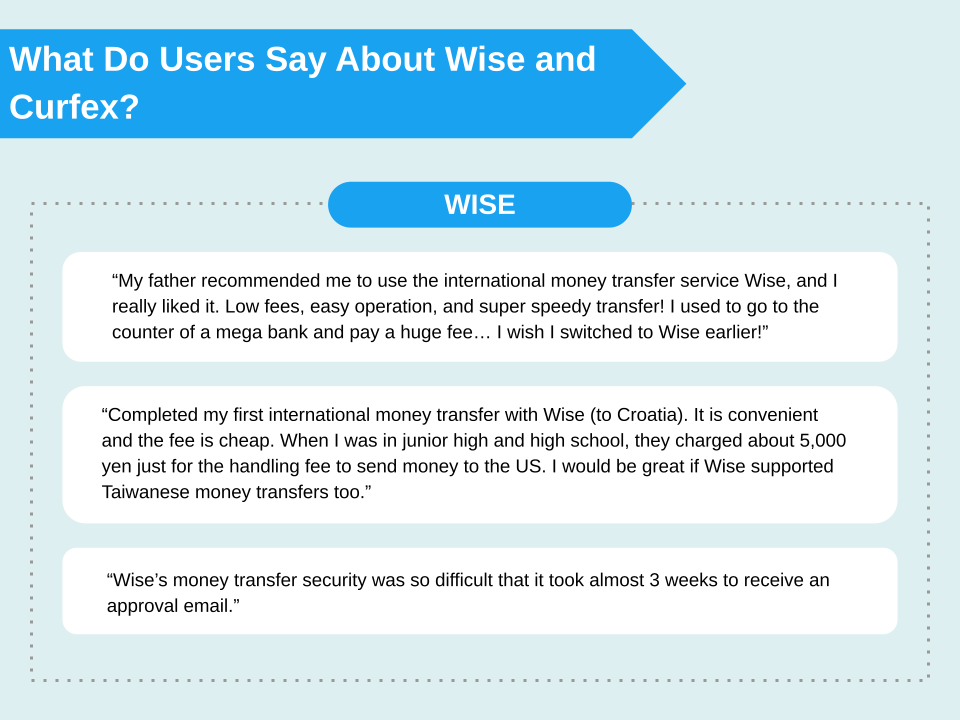
“My father recommended me to use the international money transfer service Wise, and I really liked it. Low fees, easy operation, and super speedy transfer! I used to go to the counter of a mega bank and pay a huge fee… I wish I switched to Wise earlier!”

“Completed my first international money transfer with Wise (to Croatia). It is convenient and the fee is cheap. When I was in junior high and high school, they charged about 5,000 yen just for the handling fee to send money to the US. I would be great if Wise supported Taiwanese money transfers too.”

“Wise’s money transfer security was so difficult that it took almost 3 weeks to receive an approval email.”


Many have expressed surprise at the simple operation and smooth procedure. Some have commented that they were able to save the large fees charged by banks since they started using Wise.

Since it is a well-known service, Wise receives a variety of comments, making it an easy service to refer to the users' opinions.

Reviews from Fukupochi Users


The following reviews were from Fukupochi (formerly Curfex Japan)’s users.

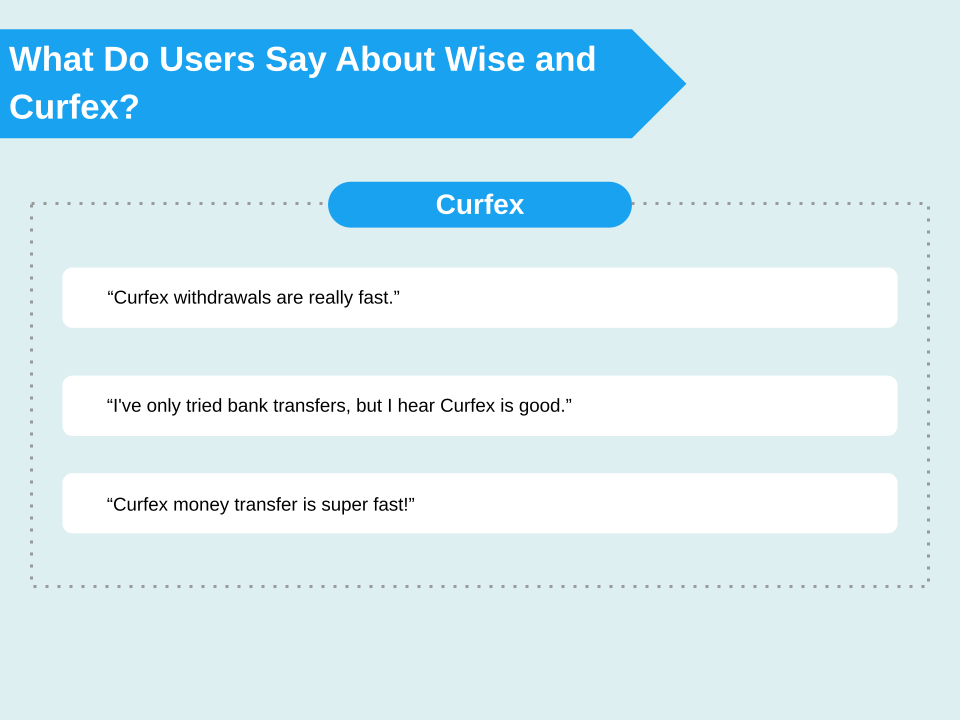
“Curfex (Fukupochi) withdrawals are really fast.”

“I've only tried bank transfers, but I hear Curfex (Fukupochi) is good.”

“Curfex (Fukupochi) money transfer is super fast!”

Many Fukupochi reviews were highly praised for the speed and convenience of the money transfer process.

The quick transfer also seems to be very popular with those who use foreign exchange services often.

Also, Fukupochi did not have as many user reviews as Wise, since it is relatively a new service that is just starting to attract attention. Some users commented that they have heard of the good reputation but had not yet used the service. This is a good indication that Fukupochi is a service that is likely to see a rapid increase in the near future.

Both Wise and Fukupochi are international money transfer services with attractive features.

The best service to use will depend on what your priority is, so here is our view on recommended international money transfer services depending on your needs.

For Those Who Prioritize Name Recognition

If name recognition is important to you, and you would like to refer to many user reviews, Wise is a good choice.

Wise is one of the best-known international money transfer services in Japan. Due to this, a large number of user reviews are available, so we recommend Wise to those who would like to check user reviews as a reference.

Meanwhile, Fukupochi is a service with a growing number of users in Japan in recent years. It is an excellent service that may well surpass Wise in the future, but at this point, it can be said that Wise is better known.

For Those Who Prioritize a Low Fee

Although both services have low fees, we recommend Fukupochi if you want to keep your fees as little as possible.

As mentioned previously, Fukupochi is currently offering a campaign with a first-time fee waiver. If you are only planning to send money once, you can definitely take advantage of this campaign. Even if you are going to send money multiple times, you will benefit greatly if you plan to send a large amount with the first transfer.

As for the fees for the second and subsequent transfers, Wise charges a fixed fee for each country, so the fee will vary depending on which country you send money to.

Fukupochi has a flat 1% fee for the second and subsequent transactions, so you can rest assured without the worry of fluctuating fees.


Fukupochi has a fixed fee of 1%, but Wise's fee varies depending on the country to which you send money.

How big of a difference would there be between Wise and Fukupochi in the transferring amount, processing time, and other factors depending on the destination? We will present some examples below.

Money Transfers to Korea

If the remittance destination is Korea, how would the processing time and fees be for Wise and Fukupochi?

In addition to the two services, the article below compares some other commonly used international money transfer methods for sending money to Korea.

https://curfex.ghost.io/international-money-transfer-service-comparison-for-korea-en/

Money Transfers to China

The article below compares Fukupochi and Wise, as well as some other commonly used international money transfer methods for sending money to China.

https://curfex.ghost.io/transferring-money-family-friends-china-en/

Money Transfers to Thailand

Visit the article below to check the simulation of the processing time and fees with Wise and Fukupochi, as well as some other commonly used international money transfer methods for sending money to Thailand.

Money Transfers to the U.S.

Visit the article below to check the simulation of the processing time and fees with Wise and Fukupochi, as well as some other commonly used international money transfer methods for sending money to the US.

https://curfex.ghost.io/money-transfers-japan-us-basic-knowledge-en/

Money Transfers to Europe and Germany

Visit the article below to check the simulation of the processing time and fees with Wise and Fukupochi, as well as some other commonly used international money transfer methods for sending money to Europe, including Germany.

Achieve a Smooth Money Transfer Using International Money Transfer Services!

When choosing an international money transfer service, be sure to check in advance the fees, processing time, the availability of benefits, and the security of the service, and choose a company that provides the service meeting your needs.

Both Wise and Fukupochi are services that are currently attracting a lot of attention. In particular, Fukupochi's first-time fee waiver campaign allows users a money transfer at an extremely low price, so it is a service we can recommend with confidence. Fukupochi is also dedicated to the Japanese market, so it offers excellent support for Japanese people, including a chatbot that allows them to easily ask questions when they need help.

If you plan to use international money transfers soon, we highly recommend signing up with Fukupochi now and be ready for your first-time transfer at no charge!

https://www.fukupochi.co.jp

References:
https://wise.com/jp/
https://wise.com/jp/terms-of-use
https://wise.com/jp/blog/revolut-wise-comparison
https://www.watch.impress.co.jp/docs/news/1307840.html
https://www.fukupochi.co.jp
https://emotional-link.co.jp/kaigaifx/curfex/
https://fxex.jp/curfex/
https://twitter.com/aikanium/status/1605528270543286272
https://twitter.com/naruminzzz/status/1605047663699034112
https://twitter.com/uyu5k/status/1607482425868947457
https://twitter.com/Dr_Golder/status/1166603451603783681
https://twitter.com/gold_coconat/status/1348551661413810177
https://twitter.com/LZBkadjQ1ioLcCw/status/1428209860085121024

Recommended International Money Transfers Services for Studying Abroad

2026-03-10  |  Fukupochi (Formerly Curfex Japan)

Are you planning on studying abroad sometime soon?

Are you worried that you might have missed something in your preparations?

If you have plans of studying abroad, you are probably excited about living in a new country, but you may also feel worried about preparations.

Especially if it is your first time traveling abroad, you may be too busy with passport preparations, packing, etc, and have no time for being excited.

One thing that many people tend to put off is the preparation for international money transfers.

Even if they have plans to receive money from family and friends living in Japan, many people put off the account setup because they can complete the process easily after moving to the country.

However, international transfers require complex procedures, such as identification, which must be completed in advance. If you fail to complete the account setup while in Japan, you will not be able to send money when you wish to.

In this article, we will introduce international money transfer services that are recommended to use while studying abroad. Make sure to create an account before leaving Japan so that you are prepared to send and receive money anytime.

When International Money Transfers are Needed While Studying Abroad

What are some situations where you will need money transfers while studying abroad?

In this section, we will introduce some examples based on people’s experiences.

When Receiving Living Expenses from Family

If you wish to receive living expenses from your family on a regular basis, you will likely use international money transfers.

For a long-term stay over several months, it is more common to receive a fixed amount of monthly living expenses from family members rather than receiving a lump sum in advance.

However, it is a surprisingly common mistake to forget to complete the setup beforehand and realize that you are not prepared to receive money a month into studying abroad. You would be in a very difficult situation where you will not be able to receive money until an account is set up.

If you plan to have living expenses sent to your study abroad destination, be sure to open an international money transfer account beforehand.

When Purchasing Additional Study Materials

The second case is when you need to purchase additional study materials at your overseas study destination.

In addition to the previously planned expenses, you may need to purchase additional study materials at the school in your study abroad destination.

Such unexpected expenses can cause you to run out of money and end up borrowing some from a local friend. Having an international money transfer account that allows you to exchange money between you and your family helps you avoid such inconveniences as well.

When You Lost Money Due to Unexpected Troubles

The last possible situation is when you encounter unexpected money-related problems, such as losing your wallet.

When living abroad, it is important to be prepared for unexpected problems, such as losing your wallet or having your belongings stolen. If you are a tourist and are not familiar with the local language, you may also be seen as an easy target for a scam.

Some students who studied abroad have experienced such problems as being pickpocketed on a train and having to live in poverty until they managed to open an international money transfer account.

Even if you believe you have enough money to live, there will always be unexpected problems when living abroad. It is essential to plan and be prepared financially for such situations.

Types of Costs Incurred When Sending Money Overseas


So, what types of costs are incurred when using international money transfers? In addition to monetary costs, we will also discuss time costs in this section.

Remittance Fee

Remittance fee refers to the fees incurred by the bank or financial institution that handles your international money transfer. The amount defers depending on the institution, so it is a cost that users can minimize as much as possible.

Currency Exchange Fee

A currency exchange fee is charged when converting the currency of the original country to the currency of the destination country for international money transfers.

International money transfers are usually based on exchange rates, but many financial institutions set their own exchange rates by adding fees to the market exchange rate.

There are also services that use the market rate without additional fees. If you want to keep costs down, we recommend choosing one of them.

Relay Bank Fees

A relay fee is incurred when you choose to send money overseas through a bank.

When a bank sends money to another bank abroad, the money is transferred through several banks. These banks are called "relay banks," and "relay bank fees" refers to the fees charged by each of them.

International money transfer services do not charge these fees, so you can reduce the cost if you choose to send money using one of them.

Receiving bank fees

Similarly, receiving bank fees are also incurred limitedly for international money transfers handled by banks.

This refers to the fee charged by the receiving bank when the money passes through the sending bank and the relay bank to the receiving bank. Like relay bank fees, this fee is not charged with international money transfer services, so users can reduce this cost by choosing one of them.

Remittance Time

In addition to the monetary costs listed above, there are also time costs, such as the remittance time.

Remittance time is the duration it takes from the time the procedure is completed to the time the remittance is sent. Smoother and quicker procedures are more desirable because services that require fewer days to complete the transfer will reduce time costs.

Generally, it is said that it takes 5 to 7 business days to transfer money from a bank, while international money transfer services can complete the transaction in about 3 business days.

In this section, we will introduce five services that are popularly used for international money transfers by students studying abroad. We hope it will help you sort out the characteristics and advantages of each service.

Wise


Wise is an international money transfer service that began operations in Japan in 2016 and now supports transactions to 77 countries. Since it handles transactions to a variety of countries in different currencies, it is unlikely to experience problems even if you are planning to study in a place that is relatively uncommon.

Another reason for Wise’s popularity is its smartphone app, which allows users to send money without opening their computers or visiting the bank.

The service charges a fixed fee depending on the destination country, but the cost of relay bank fees and receiving bank fees can be reduced. The exchange rate is also based on the market rate, suggesting that they offer transparent information with no “hidden fees.”

The remittance is also speedy, usually completed within the same day to two business days.

Rakuten Bank


Rakuten Bank is an online bank operated by Rakuten. Since it is online, it does not require users to visit the office to make a transfer.

Since it is a bank, transfers with Rakuten Bank cost relay bank fees and a receiving bank fee. Nevertheless, the service gains a reputation for its relatively low fees among bank remittance services.

Another advantage of using a bank is that it has high credibility as a national credit institution.

Combined with the easy account opening process, Rakuten bank is recommended for those who prioritize credibility.

The transaction also has a speedy bank remittance, usually taking from one to three business days.

Japan Post Bank (Yuucho Direct)


In addition to international money transfer services over the counter, Japan Post also accepts international money transfers through an online banking service known as Yucho Direct.

The biggest attraction of Yucho Direct is that it allows users to complete the trusted procedures of Japan Post from the comfort of their homes.

If you have been using Japan Post's international money transfer service and are already familiar with its system, you may be able to achieve smoother international money transfers by using Yuucho Direct.

In addition to the remittance fee, Yucho Direct incurs more fees than most services, such as currency exchange fees, relay bank fees, and receiving bank fees.

Transactions usually take about four business days to be completed. We recommend that you complete the procedure one week in advance to ensure the remittance is on time.

SBI Remit


SBI Remit is an international money transfer service that supports transactions in over 200 countries.

Due to the availability of many destinations, this service is popularly used by many international students and business people who travel around the world.

Since it is an international money transfer service, there are no relay bank fees or receiving bank fees.

However, this service uses its own exchange rate, which means users have to pay the fee that occurs there.

The remittance can be completed within 10 minutes at the earliest, and within 2 business days at the latest, allowing a speedy transaction.

Fukupochi (formerly Curfex Japan)


Fukupochi is an international money transfer service that allows transactions to 50 countries, with a growing number of users in Japan in recent years.

Characterized by its low remittance fee and speedy service, Fukupochi is currently running a fee waiver campaign for first transfers, allowing users to complete their first transaction with no fees. The fee after the second time is also low and flat at 1% of the amount transferred.

The exchange rate is the same as the market rate, and there are no “hidden fees,” so this service is highly regarded as a user-friendly service that does not charge more than necessary.

Another attractive feature of Fukupochi is that it allows for speedy transactions, with remittance times ranging from the same day to within two business days. As a money transfer company licensed by the Financial Services Agency, users can rest assured that their money will be transferred even in the event of a default on the company’s end.

Although it may not be as well known as other services, Fukupochi is an international money transfer service that is attracting a lot of attention for its security and low fees.

Summary of Each Service

The table below compares the fees for each of the international money transfer services introduced above. Use it as a reference for choosing a service when sending money to another country.


Wise

Rakuten Bank

Yuucho Direct

SBI Remit

Fukupochi (formerly Curfex Japan)

Type of service

International money transfer

Bank transfer

Bank transfer

International money transfer

International money transfer

Fees

Remittance fee:

A flat fee depending on the destination country

Remittance fee:

750 yen


Yen remittance fee: 3,000 yen


Relay bank fee: 1,000 yen


Receiving fee: 

Set by the receiving bank

Remittance fee:

3,000 yen


Currency exchange fee:

Determined based on its own exchange rate


Relay bank fee: 

Determined after the transaction is finalized


Receiving fee: 

Set by the receiving bank

Remittance fee:

880 yen for remittances from 1 to 30,000 yen


1,480 yen for remittances from 30,001 to 250,000 yen


1,980 yen for remittances over 250,001 yen


Currency exchange fee:

Determined based on its own exchange rate

Remittance fee:

Fee waiver for the first transfer (1% of the amount transferred from the second time)

Simulation: received amount when sending 100,000 yen to the 

U.S.

743.39 USD

725.97 USD

Can be confirmed after signing up

727.84 USD

745.00 USD


Some services charge a flat fee no matter where the money is sent, while other services charge different fees depending on the destination country.

The remittance time also tends to vary depending on the destination country, so it is important to check the cost in advance.

In this section, we will look into the difference depending on the destination, using several countries as examples.

Money Transfers to Korea

If the remittance destination is Korea, how would the processing time and fees be for each international money transfer service and financial institution?

Visit the link below to find a comparison of not only the international money transfer services listed above but also services commonly used in the country.

https://curfex.ghost.io/international-money-transfer-service-comparison-for-korea-en/

Money Transfers to the U.S.

The article below compares the processing time and fees for international money transfer services in this country, as well as some other commonly used international money transfer methods for sending money to the U.S.

https://curfex.ghost.io/money-transfers-japan-us-basic-knowledge-en/

Money Transfers to China

Visit the article below to check the simulation of the processing time and fees with the international money transfer services listed, as well as some other commonly used international money transfer methods for sending money to China.

https://curfex.ghost.io/transferring-money-family-friends-china-en/

Money Transfers to Germany

Visit the article below to check the simulation of the processing time and fees with the international money transfer services listed, as well as some other commonly used international money transfer methods for sending money to Germany.


Money Transfers to the U.K.

Visit the article below to check the simulation of the processing time and fees with the international money transfer services liste, as well as some other commonly used international money transfer methods for sending money to the U.K.


Prepare for International Money Transfers Before Studying Abroad!

Despite its essentiality, many people tend to put off the preparation of international money transfers when studying abroad.

While many assume that receiving money abroad would be as smooth as domestic money transfers, international money transfers are a complex process that requires prior identity verification and security checks.

It is very important to prepare beforehand because once in the country, it is common to be so busy getting used to the new lifestyle that you do not have time for such procedures.

Among the international money transfer services introduced in this article, Fukupochi is especially recommended for those who are planning to study abroad.

If you sign up with Fukupochi now and use the fee-waiver campaign, you can complete your first transfer at no charge. In addition, the transfer is very speedy, allowing you to send and receive money even upon urgent needs.

If you plan to study abroad soon, we highly recommend signing up with Fukupochi now and being ready for your first-time transfer at no charge!

Click here to sign up

https://www.fukupochi.co.jp


References:
https://www.remit.co.jp/kaigaisoukin/sendremittance/
https://ires.remit.co.jp/IRESWeb/MainCommissionSimulator_Input.jsf
https://www.remit.co.jp/kaigaisoukin/exchangeratecommission/commission/